
EU CRD6 Directive and Morocco-France Agreement: What Changes for MRE Transfers in 2026
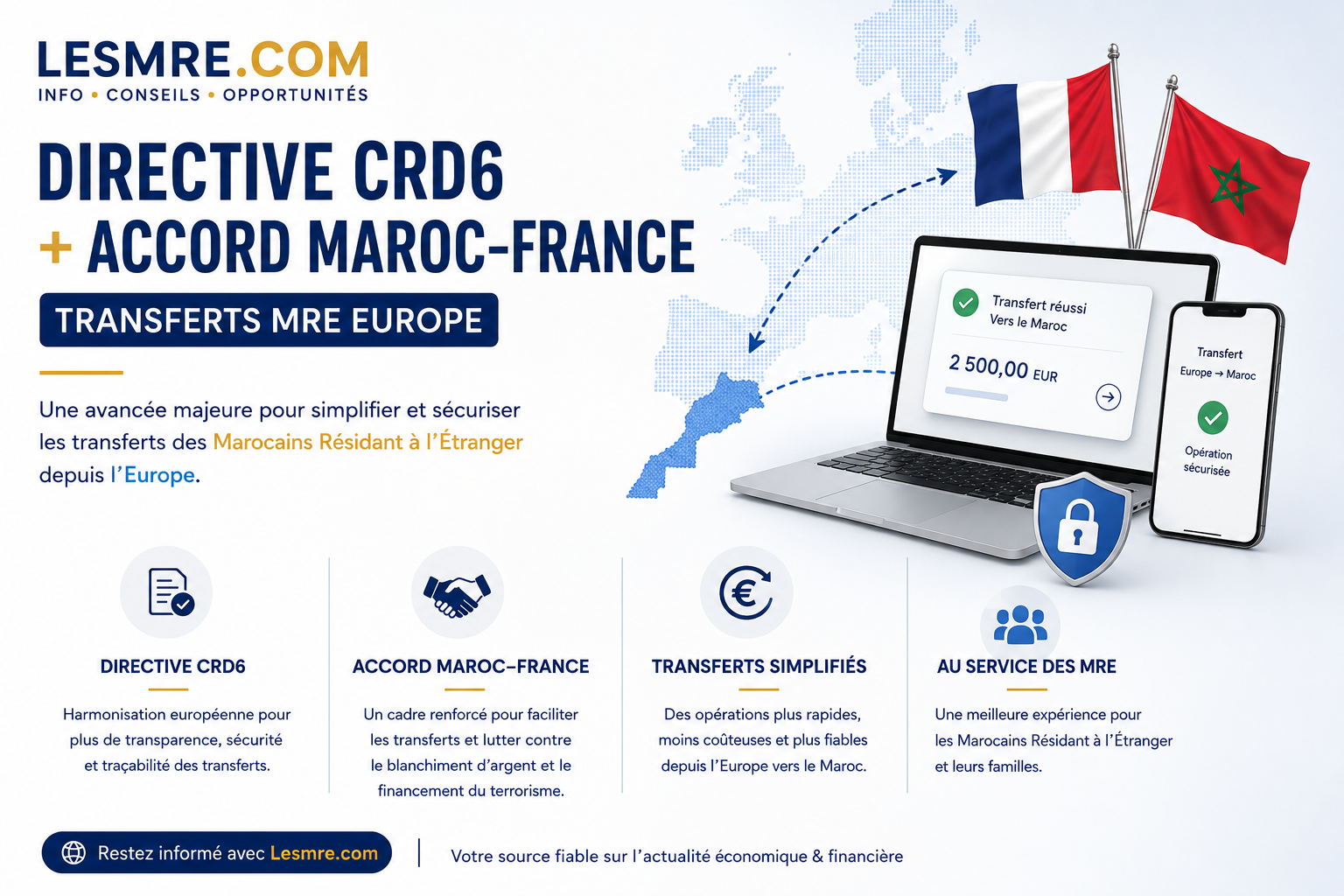
The EU CRD6 directive in force since 10 January 2026 imposes a stricter framework on non-European banks operating in the Union. Bank Al-Maghrib has secured a decisive breakthrough with France to preserve MRE remittances (MAD 122 billion in 2025). State of play and what it concretely means for MRE in Europe.
Remittances from Moroccans residing abroad reached MAD 122 billion in 2025 (+2.6 % year-on-year), of which about EUR 11 billion came from the European Union. This strategic resource now faces a new regulatory framework: the European CRD6 directive, in force since 10 January 2026, which tightens the rules applicable to non-European banks operating in Europe. Bank Al-Maghrib has secured a decisive breakthrough with France. Here is where the file stands and what this concretely means for MRE.
The CRD6 directive in two paragraphs
Directive 2024/1619, known as CRD6, was adopted by the European Parliament on 31 May 2024 and published in the Official Journal of the EU on 19 June 2024. It follows on from Brexit and aims to strengthen the financial stability of the EU by tightening the framework for third-country (non-EU) banks operating on European soil.
In practice, branches of third-country banks must now comply with reinforced obligations on governance, capital, transparency and depositor protection. If they fail to comply, these branches must convert into legally independent subsidiaries with heavier capitalisation requirements. The text has been applicable since 10 January 2026.
Why Moroccan banks are affected
Several major Moroccan banks operate European branches serving the diaspora: branches and representation offices in Paris, Brussels, Madrid, Amsterdam, Milan, Frankfurt. These touchpoints handle account opening, transfers to Morocco, Moroccan mortgages originated from Europe, and support for MRE projects (business, real estate, succession).
Under CRD6, these branches are under pressure. Either they comply with the new EU prudential framework (heavy on capital and governance), or they convert into local subsidiaries (legally autonomous and capitalised at EU level), or they obtain regulatory equivalence validated by the European Commission on the basis of a bilateral agreement.
It is this third path that Bank Al-Maghrib has advanced with France.
The Morocco-France agreement: a decisive breakthrough
Bank Al-Maghrib Governor Abdellatif Jouahri announced in March 2026 a decisive breakthrough with France. A bilateral agreement between Banque de France and Bank Al-Maghrib has been finalised and now awaits formal validation by the European Commission.
This agreement recognises the equivalence of the Moroccan prudential framework for the activities of Moroccan banks in France. Once validated by Brussels, it will allow Moroccan branches to continue their activity in France without major hindrance and without converting into subsidiaries.
This validation also opens the door to similar negotiations with other European countries hosting a significant Moroccan diaspora. Discussions are already engaged with the Netherlands and Belgium, and should soon extend to Italy, Spain and Germany.
Why this is strategic for MRE
Three concrete stakes lie behind this file.
First, the historical banking channel. Nearly 60 % of MRE transfers to Morocco transit through Moroccan banks themselves, either via direct accounts or through their partnerships with local networks. If this channel were weakened, transfer costs could rise and delays lengthen.
Second, Moroccan mortgages originated from Europe. Several Moroccan banks offer through their European branches mortgage products in dirhams or euros to MRE investing in Morocco. These products depend on the branches' ability to continue their activities in Europe.
Third, support for MRE-backed SMEs. Moroccan banks support from Europe productive investment projects in Morocco: business creation, equipment imports, export financing. This B2B dimension is less visible than family remittances but economically strategic.
What this concretely changes for you in 2026
For an MRE in France, the agreement being finalised means nothing changes in the short term. Accounts opened in Moroccan branches in France remain operational, transfers to Morocco continue at standard rates, and Moroccan mortgages remain available from France.
For an MRE in Belgium, the Netherlands, Italy, Spain or Germany, the situation is in flux. Until the Morocco-EU agreement is extended to your country of residence, local Moroccan branches may have to adapt their offering or even restructure. No mass closures are expected in the short term, but a period of uncertainty is opening.
Concretely, three precautions to take now.
Keep all your transfer receipts to Morocco from the last 12 months. In case of a forced change of banking channel, they will make the migration of your flows to another operator easier.
Check whether you have multiple channels available: account in a Moroccan branch + account in a local European bank + account at a specialist fintech (Wise, Remitly). Diversification limits risk in case of turbulence on one channel.
For MRE with a Moroccan mortgage via a Moroccan bank in Europe, ask your adviser in writing for a status update on potential CRD6 impacts on your file. The bank's formal answer is useful in case of later dispute.
The numbers that show the stakes
The economic weight of the file is documented.
Total MRE transfers reached MAD 122 billion in 2025, about EUR 11 billion, of which more than half came from the European Union. In the first quarter of 2026, transfers already cumulated MAD 29.7 billion by end of March (Office des Changes).
In aggregate, transfers represent about 8 to 9 % of Moroccan GDP and finance a significant share of the balance of payments. Any severe disruption to this flow would have a direct macroeconomic impact.
This pressure explains the mobilisation of Bank Al-Maghrib and the Ministry of Economy and Finance on the CRD6 file since late 2024.
What to watch in the coming weeks
Three milestones shape the 2026 calendar.
Formal validation by the European Commission of the Morocco-France agreement. No official date is announced but it is expected during the second half of 2026.
The opening of bilateral negotiations with the Netherlands, Belgium, Italy, Spain and Germany. Depending on the pace adopted, the extension of the framework to other European countries will take 12 to 36 months.
Possible adjustments to the offering of Moroccan branches in Europe. Official bank communications, changes in pricing conditions, changes of channels or local banking partners: all signals to track.
Sources and references
The full text of the CRD6 directive (EU directive 2024/1619) is available on EUR-Lex eur-lex.europa.eu. Bank Al-Maghrib publishes its policy notes on bkam.ma. The Council of the Moroccan Community Abroad (CCME) ccme.org.ma maintains regular monitoring of strategic diaspora files.
To follow the file on an ongoing basis, the reference Moroccan press sources are Le360, Maroc Hebdo, l'Economiste Maghrebin and Medias24. The Ministry of Economy and Finance publishes its official communications on finances.gov.ma.
For an MRE facing a specific question about an account or mortgage in a Moroccan branch in Europe, the first step is to request a meeting with your banking adviser for a written update on the CRD6 impact on your file. In case of dispute, the Office des Changes and the Moroccan Banking Mediator (gpbm.ma) are the second-level contacts.
See also: Neobank and traditional bank: what changes for MRE in 2026
Related articles


Related practical guides
Are you an MRE?
Join the platform and reach verified professionals in Morocco. Free.
Have a project in Morocco?
Find a LesMRE-verified expert to guide you through your steps.
Find an expert →