
Dakhla: 1,090 hectares irrigated by desalination to anchor agricultural development
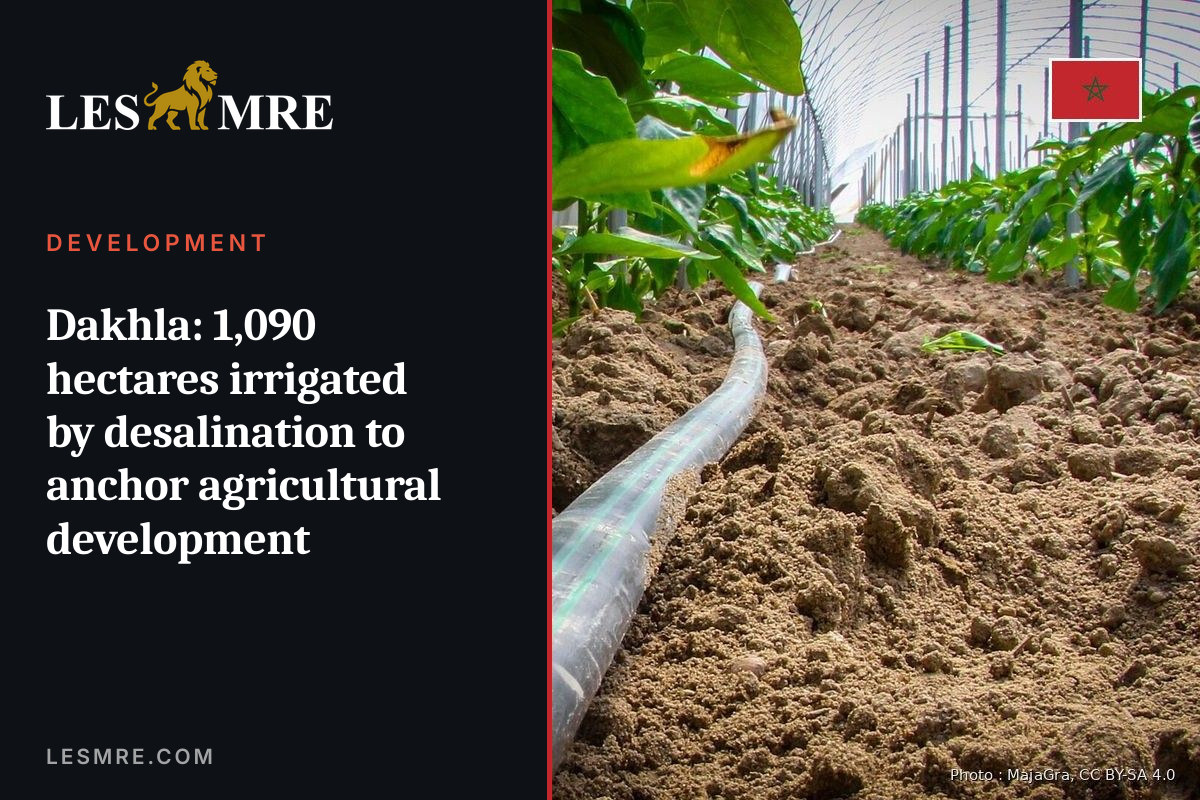
According to Bladi, 35 farms on 1,090 hectares in Dakhla are allocated via investor call, with a desalination plant and drip irrigation, contracts of 25 to 40 years, adjustable rents and a ban on transfer without authorization.
On 18 July 2026, the terms for awarding 35 agricultural holdings in Dakhla were made public. The project converts 1,090 hectares into irrigated land thanks to a desalination plant and drip irrigation, in an area where “water scarcity has until now limited production possibilities”, according to Bladi.
A large‑scale hydraulic and agricultural project
The call for investors states that “beneficiaries must operate the plots directly and may not transfer them without authorisation”. Contracts run for 25 years, extended to 40 years if the project includes an industrial activity linked to production. “Rents will be revised periodically and will be added to connection charges and the cost of water,” the same outlet details. The desalination plant will supply water distributed by drip irrigation “in order to limit losses in this particularly arid region”. The scheme explicitly aims to “attract long‑term investment and create economic activity around agriculture, processing and hydraulic infrastructure”.
Consolidation of the Atlantic coastline as a strategic lever
This announcement fits into a broader sequence. On 1 December 2023, on the occasion of the 48th anniversary of the Green March, King Mohammed VI announced “the continuation of development drives through the consolidation of the national coastal area, including the Atlantic coast of Moroccan Sahara, and the structuring of this geopolitical space at the African level”, reports Atalayar. Morocco has “two coastlines totalling 3,500 kilometres, of which roughly 3,000 kilometres lie on the Atlantic and 500 kilometres on the Mediterranean”.
The new industrial port of Dakhla, “a megaproject structuring the new development model for the Saharan provinces”, is due to be completed “by the end of 2028”. It is presented as a “strategic lever to confirm the Kingdom’s African anchorage and better exploit its Atlantic dimension”. The Atlantic vision also rests on the Ministerial Conference of African Atlantic Rim States, created in 2009 in Rabat to “establish a zone of peace, security and prosperity” and “defend the continent’s strategic interests with a single voice”. Twenty‑three African countries have an Atlantic coastline, representing “46 % of the African population, which alone accounts for nearly 55 % of the continent’s GDP”.
At the same time, the Morocco‑Nigeria gas pipeline project, stretching 7,000 kilometres across several countries, has taken a step forward with the signing of an agreement between Morocco, Nigeria and ECOWAS. Studies are “currently at an advanced stage” for what could become “the world’s longest subsea gas pipeline” before reaching Europe.
Sovereignty exercised through investment and infrastructure
The facts demonstrate continuity: the port, the gas pipeline, the ministerial conference and now the Dakhla irrigated perimeter form a coherent whole. Desalination‑driven irrigation lifts the water constraint that had frozen agricultural potential. Contractual terms of 25 to 40 years provide the profitability horizon required by capital. The prohibition on transfer without authorisation and the obligation to operate directly limit land speculation. The cost of water and connection fees are built into the economic model, with no hidden subsidy. The Dakhla port, whose works are progressing towards 2028, will ensure the export of produce. The gas pipeline, in the final study phase, promises competitive energy for the processing industry. The 2009 Atlantic conference provides the multilateral diplomatic framework.
Agriculture in Dakhla is no longer a pilot experiment but a component of a production model backed by heavy infrastructure and an assumed regional strategy.
Sources
- •Atalayar (atalayar.com), 1 December 2023
- •Bladi (bladi.net), 18 July 2026
Related articles
Related practical guides
Are you an MRE?
Join the platform and reach verified professionals in Morocco. Free.
Have a project in Morocco?
Find a LesMRE-verified expert to guide you through your steps.
Find an expert →