
Liège riots and school blockades in Belgium: what a young man of Moroccan origin arrested risks
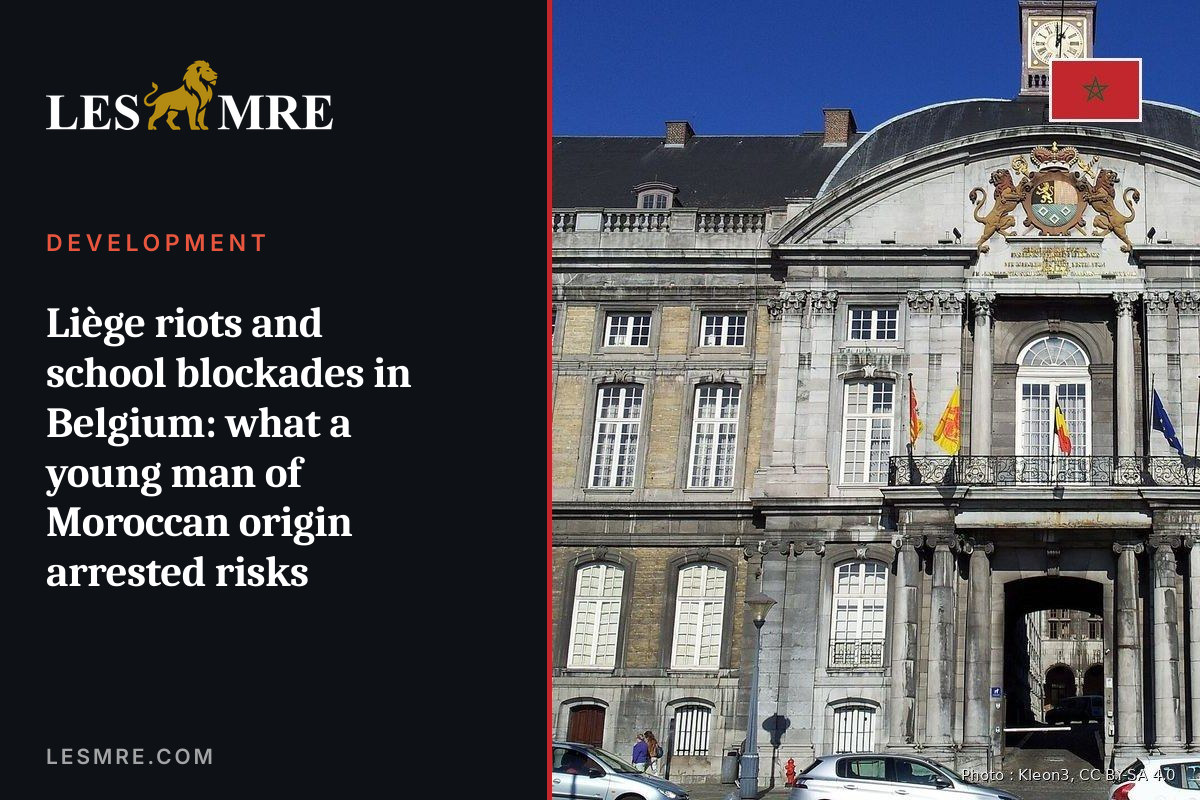
Since October 1, Liège police arrested 194 people, including 114 minors. The student movement, sparked by increased teaching hours, spread to Mons, Charleroi and Brussels. Moroccan families worry about consequences for arrested youths, including penal measures, residency rights and Belgian nationality.
Liège is now the epicentre of Belgian secondary school anger. Since 1 October, local police have made 194 arrests there, including 114 minors, and 43 police officers have been injured (figures as of 8 October, reported by VRT). The mayor has banned all gatherings of more than 3 people until 16 October. The movement has spread to Mons, Charleroi and Brussels. For Moroccan families in Belgium, two questions arise: where does this movement come from, and what are the risks for a young person who is arrested?
Anger born in school
At the root of it, a measure from the Wallonia-Brussels Federation: since the start of the school year, teachers in the final three years of secondary school are teaching 22 hours a week instead of 20. Add to that budget cuts and a rise in student tuition fees. Pupils are mobilising in support of their teachers, following the lead of the French school student movement, but with their own specific demands.
On 9 October, another demonstration filled Brussels: the national march by the FGTB and CSC trade unions against the federal government's policies, with 30,000 participants according to police and 50,000 according to the FGTB. Scuffles broke out on the sidelines, near Brussels Central Station and Brussels Midi Station.
What politicians are saying
This time, the dominant frame is not immigration. Interior Minister Bernard Quintin points to "the responsibility of parents, schools, but also the anti-fascist movement". Defence Minister Theo Francken and Georges-Louis Bouchez are pointing the finger at TikTok and calling for sanctions against parents. Our research has so far found no statement from Vlaams Belang linking these riots to immigration.
Yet there is a precedent. On 27 November 2022, after Morocco's World Cup victory against Belgium, violence erupted in Brussels. Tom Van Grieken, leader of Vlaams Belang, then declared: "We have a Moroccan problem." The tally for that evening, according to Reuters and AFP: 1 judicial arrest and 12 police detentions, in a city where thousands of supporters had celebrated the victory without incident.
What is established: Belgium collects no data on the origin of people stopped or arrested. No source has published the origin or nationality of the young people arrested in Liège, Charleroi or Brussels. Any claim about their origin is based on no figures whatsoever.
Arrested: what happens
Administrative arrest, the most common during a demonstration, cannot exceed 12 hours. For a minor, the person with legal custody is automatically informed. Judicial arrest lasts a maximum of 48 hours before a judge's decision, with the right to a lawyer from the very first hearing (Police Function Act, Constitution, "Salduz" laws).
What the new Criminal Code provides
Since 1 September 2026, a new Criminal Code applies in Belgium. It classifies penalties into 8 levels and states that prison is a "last resort" (Article 27). For the most common offences during demonstrations:
- •simple rebellion: level 1, no prison, fine of 200 to 20,000 euros or alternative penalty (Article 644);
- •collective rebellion, by two or more people: level 3, more than 3 to 5 years (Article 645);
- •simple vandalism: level 1; on a public building or means of transport: level 2, or even level 3 if the damage is serious;
- •violence against a police officer or a teacher: levels 2 to 5 depending on severity (Article 202);
- •arson of a building or means of transport: level 3, or even level 4.
One provision young people should know about: anyone who takes part in a collective rebellion without being a ringleader, and who withdraws at the first warning from the authorities, is not punished (Article 646).
Minors
A minor does not receive a penalty but measures, according to the 2018 decree of the Wallonia-Brussels Federation. Under 12 years of age, only a reprimand is possible. Placement in a public institution (IPPJ) is in principle reserved for young people aged 14 and over, for serious offences. Referral to adult justice is only possible from age 16 and under strict conditions.
For a young person of Moroccan nationality, what is added
Residence. The law of 15 December 1980 allows for the termination of a foreign national's residence "on grounds of public order" (Article 21). For a foreigner who has been legally settled or established for at least 10 years, "serious grounds" are required (Article 22). The decision must be based on personal conduct and a real, current and sufficiently serious threat, taking into account the length of residence, ties with Belgium and family (Article 23).
A young person born in Belgium or who arrived before the age of 12 is better protected: according to the Constitutional Court (ruling 112/2019), their removal is only possible in cases of terrorism or very serious criminality. For a family member of a Belgian national, a conviction alone is not sufficient (Article 45).
Nationality. To acquire Belgian nationality, "serious personal facts" can close the door, and the King's Prosecutor can issue a negative opinion (Nationality Code, Articles 1 and 15). A Belgian-Moroccan who holds Belgian nationality from a Belgian parent at birth cannot be stripped of it. For others, forfeiture requires a final prison sentence of at least 5 years for a serious offence listed in a law.
Police stops
Lacking official statistics, the data remains partial. In 2018, Amnesty International interviewed 48 police officers across 9 zones, including Liège, Charleroi and Brussels: half acknowledged a problem of ethnic profiling. The EU's FRA survey (data from 2008) measured that 24% of North Africans had been stopped within 12 months, compared to 12% of the majority population in the same neighbourhoods. Conversely, a study commissioned by Unia on a Brussels-North zone did not conclude there was "systemic" profiling.
What families need to know
An arrest on the sidelines of a school blockade most often ends without prison, especially for a minor. But for a young person without Belgian nationality, it can leave a mark that will weigh heavily on the day they apply for a residence permit or nationality.
Sources: VRT NWS, 8 October 2026; Paris Match Belgium, 6 October 2026; La Libre, 8 October 2026; L'Avenir, 9 October 2026; Reuters and AFP, 28 November 2022; RTBF, 28 November 2022; SPF Justice; Justel (new Criminal Code, law of 15 December 1980, Nationality Code, Police Function Act); decree of the Wallonia-Brussels Federation of 18 January 2018; Constitutional Court, ruling 112/2019; Amnesty International Belgium, 2018; EU Agency for Fundamental Rights; BX1, 3 July 2020.
Related articles
Related practical guides
Are you an MRE?
Join the platform and reach verified professionals in Morocco. Free.
Have a project in Morocco?
Find a LesMRE-verified expert to guide you through your steps.
Find an expert →