
AfDB 2026 Report: $13 Billion in MRE Remittances, Only 10% Invested in Morocco
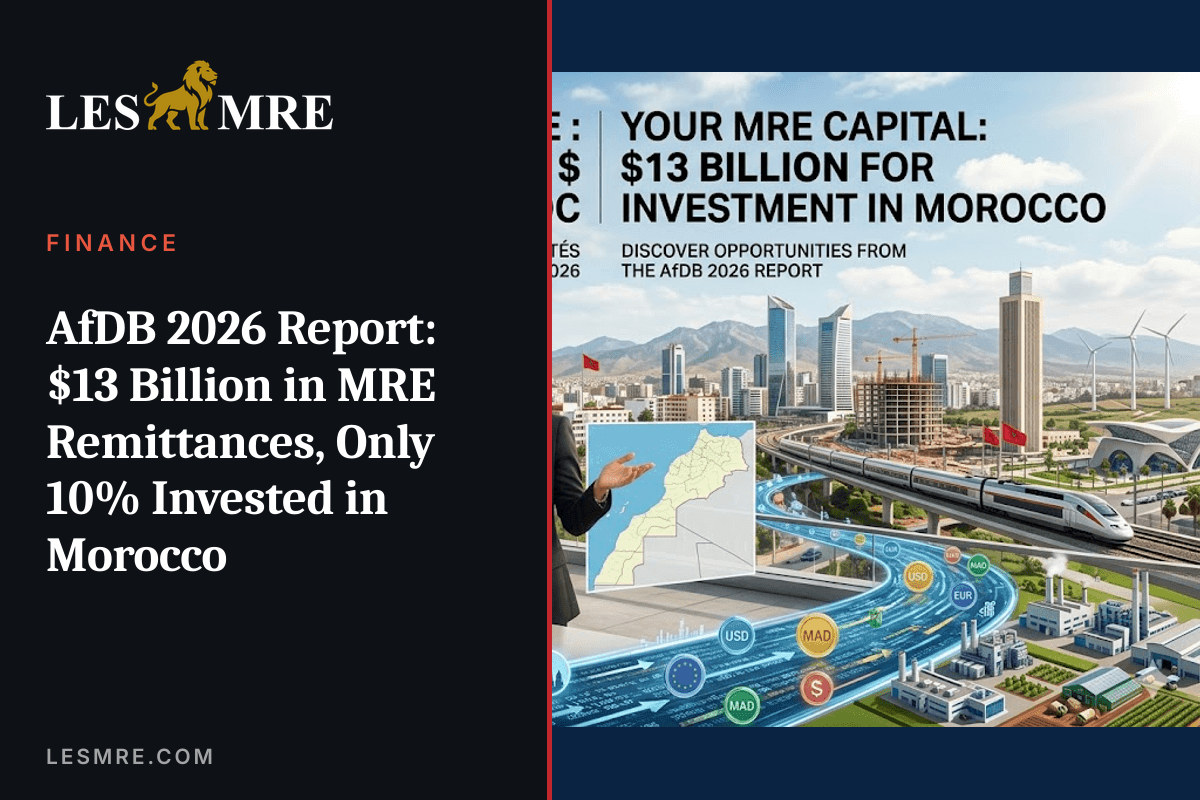
The AfDB 2026 report and the Tangier forum put a fact back on the table: of the 122 billion dirhams sent by MRE in 2025, only 10% goes to productive investment. What the report says, why this money sleeps, and how to put it to work in Morocco.
TL;DR
- •The African Development Bank (AfDB) flagship report, the African Economic Outlook 2026, was launched on 26 May 2026 in Brazzaville, on the theme of mobilizing Africa's development financing in a fragmented world.
- •It lists diaspora financing among the levers to close a financing gap of 1.3 trillion dollars a year and unlock up to 1.43 trillion a year with reforms.
- •In Morocco, MRE remittances reached 122 billion dirhams in 2025 (about 13.3 billion dollars, +2.6%), or more than 7% of GDP. A record that exceeds foreign direct investment.
- •But according to the Moroccan government, only about 10% of that sum goes to productive investment. The rest goes to household consumption, real estate and savings.
- •The Tangier forum (21-22 May 2026), under Royal High Patronage, aimed precisely to turn this windfall into investment.
The AfDB 2026 report: what it covers
The African Economic Outlook is the African Development Bank's flagship report. The 2026 edition, launched in Brazzaville at the AfDB Annual Meetings, carries a clear message: African growth is holding firm (around 4.2% in 2026) despite global turbulence, but the continent faces a financing gap of more than 1.3 trillion dollars a year for its development goals.
The AfDB identifies several levers to fill that gap and mobilize up to 1.43 trillion dollars a year: better revenue collection, more efficient public spending, the fight against illicit financial flows, deeper capital markets, public-private partnerships, valuing natural capital, and diaspora financing.
A point of honesty: the AfDB cites the diaspora as a lever, but without attaching a specific figure to it at the continental level. For Morocco, however, the diaspora numbers are among the most striking in Africa.
122 billion dirhams: the record and its paradox
In 2025, Moroccans abroad sent 122 billion dirhams home, a historic record up 2.6%. That is more than 7% of GDP, more than foreign direct investment. The full detail of this record and the outlook is in our dedicated article: MRE remittances: 122 billion in 2025, heading for 128 billion.
Here is the paradox: according to the Moroccan government, only about 10% of this money funds productive investment (a business, a project, a tool of work). Per estimates relayed by the economic press, 65 to 70% goes directly to households, and the rest splits between real estate and savings. In short, most of this windfall supports consumption and property, not lasting value creation.
Why this money "sleeps"
Several structural reasons explain the imbalance, and none is inevitable:
- •Family support first. A large share of remittances helps relatives day to day, which is legitimate and a priority.
- •Real estate seen as a safe haven. Buying property reassures, but locks up capital without creating activity.
- •A lack of simple, trusted channels to invest in productive assets from abroad.
- •An information gap about existing schemes (Investment Charter, AMDIE, regional investment centers, capital markets).
It is precisely this last point that the authorities are trying to fix.
The Tangier forum: turning the windfall into investment
On 21 and 22 May 2026, Tangier hosted a forum dedicated to investment by Moroccans of the world, under Royal High Patronage. About 300 participants, including more than 150 MRE investors, with AMDIE and the 12 Regional Investment Centers represented.
The Head of Government called for turning the diaspora into a strategic economic lever and going beyond the 10% ceiling of productive investment. The message echoes the AfDB's: the diaspora is a financing resource to activate, not just a source of foreign currency.
Where to invest beyond real estate
For an MRE who wants to put savings to work in Morocco, several paths exist alongside property:
- •Capital markets. The Casablanca Stock Exchange is Africa's second largest. Its market capitalization passed 1,000 billion dirhams for the first time in 2025 (about 116 billion dollars), with 78 listed companies. This is exactly what the AfDB recommends deepening.
- •Fintech. New players make cross-border transfers and investment cheaper and simpler. Watch the exchange limits: see our article on the 2026 IGOC from the Office des Changes.
- •Productive projects and public schemes (Investment Charter, AMDIE, regional investment centers), aimed precisely at project owners, including MRE.
To compare transfer channels before investing, see our guide Send money to Morocco. And if you stay with real estate, do it with eyes open via our guide Buy property in Morocco from abroad.
A fairly reassuring macro backdrop
For investing, context matters. Per the AfDB, Moroccan growth stays solid: 4.7% in 2025, around 4.2% in 2026, then 4.3% in 2027, with inflation contained at about 2.4%. A stable framework, even if growth slows slightly in 2026 due to energy.
The risks to know
The AfDB also flags headwinds worth keeping in mind before any placement:
- •Middle East tensions and energy. This is the main downside risk identified for Morocco: a surge in energy prices, worsened by a weaker dirham that raises import costs.
- •Climate and agriculture. Weather uncertainty weighs on a key sector of the economy.
- •Global trade fragmentation, the backdrop of the report, which reduces international financial flows.
These risks argue for diversified savings rather than concentration in a single asset.
Frequently asked questions
What is the AfDB 2026 report?
The African Economic Outlook 2026, the African Development Bank's flagship report, launched on 26 May 2026 in Brazzaville, focused on mobilizing Africa's development financing.
How much did MRE transfer to Morocco in 2025?
122 billion dirhams, about 13.3 billion dollars, up 2.6%, or more than 7% of GDP.
Why is only 10% invested?
According to the Moroccan government, only about 10% goes to productive investment. The rest supports households, real estate and savings, for lack of simple channels and information about the schemes.
Does the AfDB report quantify the diaspora's contribution?
No. The AfDB lists diaspora financing among development levers, but does not attach a dedicated figure to it at the continental level.
Where can an MRE invest in Morocco beyond real estate?
The Casablanca Stock Exchange, fintech solutions, and productive projects via the Investment Charter, AMDIE and the Regional Investment Centers.
What are the risks for Morocco's economy in 2026?
Middle East tensions and energy, a weaker dirham, weather-related risks to agriculture, and global trade fragmentation.
What is the Tangier forum?
A forum held on 21-22 May 2026 under Royal High Patronage, dedicated to turning the diaspora's transfers and savings into productive investment in Morocco.
Sources
- •African Development Bank, African Economic Outlook 2026 (launched 26 May 2026, Brazzaville)
- •Office des Changes (MRE remittances 2025)
- •Ecofin Agency and Morocco World News (invested share, Morocco growth)
- •Tangier Forum for Moroccans of the World, Le Matin and Yabiladi
Related articles
Related practical guides
Are you an MRE?
Join the platform and reach verified professionals in Morocco. Free.
Have a project in Morocco?
Find a LesMRE-verified expert to guide you through your steps.
Find an expert →