
MRE Savings: 222 Billion Dirhams Sitting in Moroccan Banks
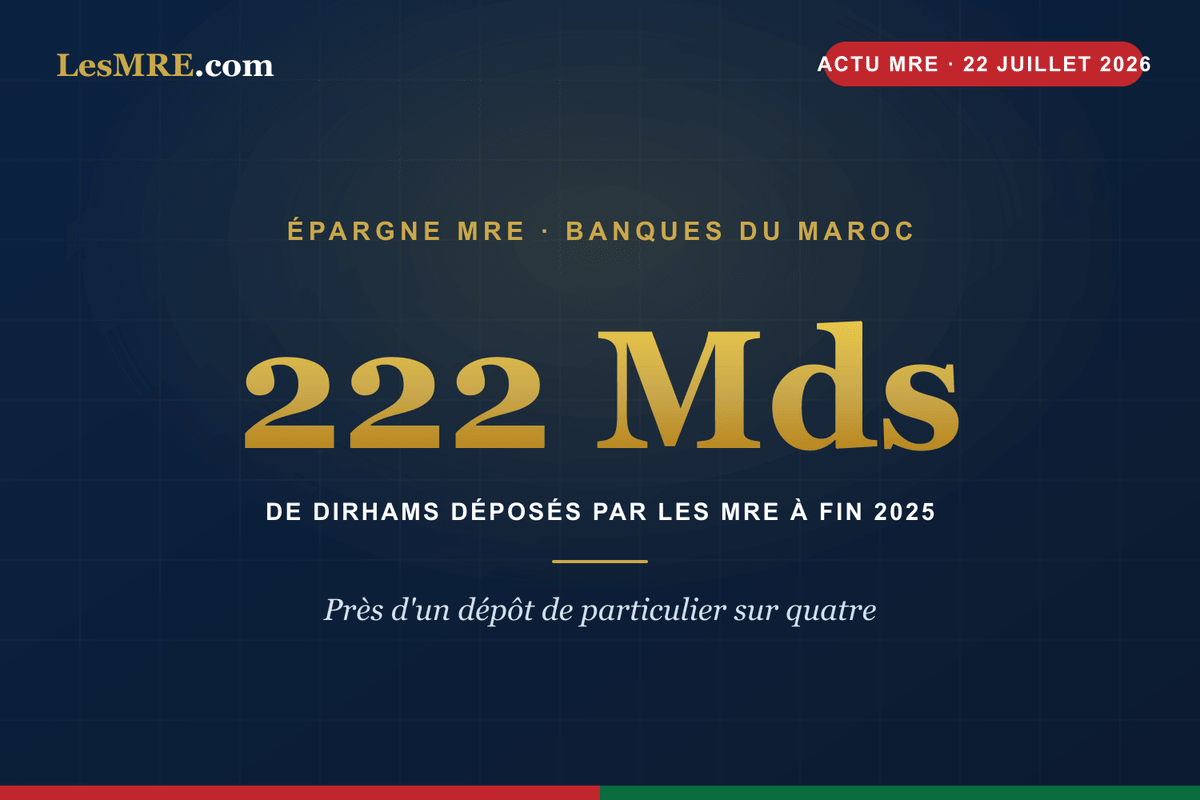
Everyone talks about summer transfers. The stock gets forgotten: 222.8 billion dirhams of MRE savings in Moroccan banks, part of it sleeping in accounts that earn nothing.
Key facts
- •At the end of 2025, Moroccans living abroad held 222.8 billion dirhams in the country's banks, according to Bank Al-Maghrib's annual report on the banking sector, released in July 2026.
- •That savings pool is worth nearly a quarter of all household deposits. Roughly one dirham in four deposited by households in Morocco belongs to an MRE.
- •The stock keeps rising: 184.8 billion in 2019, 203.5 in 2023, 222.8 at the end of 2025. Almost 38 billion more over six years. In spring 2026 it passed the 230 billion mark.
- •Alongside this stock, remittances in 2025 reached 122 billion dirhams, up 2.6%.
- •Part of this money sits in current accounts. It earns nothing, and inflation eats at it month after month.
- •The point many discover too late: only money held in a convertible account can leave Morocco freely. The type of account decides everything.
A number that tells a habit
There are the remittances everyone talks about each summer. And there is the rest, which almost no one mentions: the money that piles up and stays put. At the end of 2025, that rest reached 222.8 billion dirhams deposited by MRE in Moroccan banks.
One benchmark makes the weight clear. Household deposits in Morocco sit around 950 billion dirhams. MRE hold close to a quarter of that. It is a large share for a population that lives, works and spends elsewhere.
And it is not a one-off spike. In 2019 the stock was 184.8 billion. In 2023, 203.5. At the end of 2025, 222.8. The curve does not turn back. Every year, part of the transfers is not spent: it lands in an account and stays there.
Why so much money stays still
The first reason is human. Many MRE send money to Morocco as a precaution: a family emergency, a project taking shape, a retirement prepared from afar. That money has no immediate use. It waits. And while it waits, it sleeps.
The second reason is technical. A large share of these funds sits in current accounts, the ones used to receive and to pay. A current account does not reward savings. The money is available, but it does not work.
The third reason is distance. Tracking an investment, comparing an offer, signing a file, all of that is harder from Paris, Brussels or Montreal. By default, people leave the money where it is. It is comfortable, but it has a cost: inflation quietly reduces the purchasing power of a sum that earns nothing.
The convertible account, a line not to cross blindly
This is the most important point in this article, and the least known. In Morocco, not all of an MRE's accounts are equal under foreign exchange rules.
A convertible dirham account, fed by foreign currency transferred from abroad, keeps a valuable feature: the funds in it can be repatriated freely out of Morocco, with no special authorisation. It is the account of possible returns.
An ordinary dirham account, non-convertible, does not offer that freedom. Money that enters it is deemed to stay in Morocco. Taking it out means paperwork, and sometimes it does not happen at all.
The takeaway is simple. If you ever plan to bring part of your savings back to your country of residence, the nature of the receiving account matters as much as the amount. Many families notice this at the worst moment. Checking the exact label of your account today avoids a bad surprise tomorrow.
What you can do with it, without rushing
Letting savings sleep is not inevitable. Without giving personalised advice, which depends on your situation and belongs with your bank, a few options stand out.
A term deposit turns an account that earns nothing into a sum locked for a chosen period in exchange for interest. It is the simplest way to stop letting inflation do all the work.
Property remains the classic destination for MRE savings. Since 2026, the Office des Changes allows banks to finance up to 80% of a purchase, which we detailed in our dedicated article. A property project gives a purpose to savings that would otherwise wait aimlessly.
Repatriation is the other side of the story. When the euro or the dollar moves, the timing of the exchange is not neutral. We track this in our euro and dirham update.
Finally, the choice of bank is not a detail. Fees, remote services, conditions for non-residents: everything compares. Our comparison of Moroccan banks for MRE is a starting point. And to place this savings stock within the yearly flow of transfers, our 2025 remittances review completes the picture.
Frequently asked questions
How much have MRE deposited in Moroccan banks? 222.8 billion dirhams at the end of 2025, nearly a quarter of household deposits, according to Bank Al-Maghrib's annual report on the banking sector.
Is this savings pool growing? Yes, without interruption. It rose from 184.8 billion in 2019 to 222.8 billion at the end of 2025, and passed 230 billion in spring 2026.
Why say this money is sleeping? Because a large part sits in current accounts, which do not pay interest. The sum is available, but it produces no return while inflation reduces its value.
Can I move my savings out of Morocco? It depends on the account. Funds in a convertible dirham account, fed in foreign currency, can be repatriated freely. Funds in an ordinary, non-convertible dirham account do not enjoy that flexibility.
Do I have to invest this money? No, it is a personal choice. But leaving a sum in a non-interest-bearing account has a real cost: each year of inflation eats into its purchasing power.
Sources
- •Bank Al-Maghrib, annual report on banking supervision and the banking sector 2025, released in July 2026.
- •Bladi.net, "MRE: one dirham in four sleeps in Moroccan banks", 22 July 2026.
- •Medias24, "Banking sector: key takeaways from the 2025 review presented by Bank Al-Maghrib", 21 July 2026.
Related articles

Related practical guides
Are you an MRE?
Join the platform and reach verified professionals in Morocco. Free.
Have a project in Morocco?
Find a LesMRE-verified expert to guide you through your steps.
Find an expert →