
The Euro Buys Fewer Dirhams: What It Means for Your Transfers This Summer
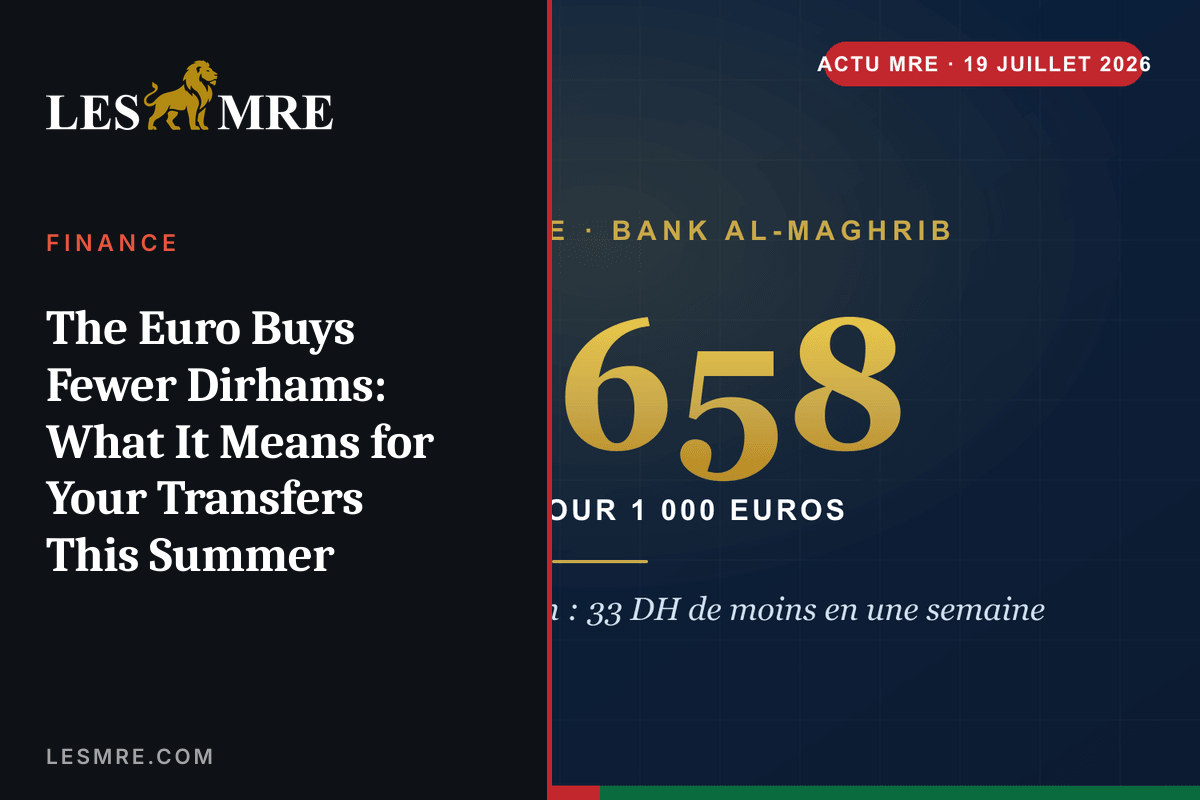
The euro reference rate slipped from 10.691 to 10.658 dirhams between July 9 and 15, 2026, according to Bank Al-Maghrib. On 1,000 euros exchanged, that is 33 dirhams less. In the middle of the Marhaba season, here is the real impact and the right reflexes to limit the loss.
Key facts
- •The dirham gained 0.2% against the euro between July 9 and 15, 2026, after an identical rise the previous week, according to Bank Al-Maghrib's weekly indicators.
- •The reference rate went from 10.691 dirhams on July 9 to 10.658 dirhams on July 15, with a low of 10.642 on July 13.
- •In practice: 1,000 euros bought 10,691 dirhams on July 9, and 10,658 six days later. That is 33 dirhams less.
- •The loss is modest on a single operation. It weighs more on large transfers, and it comes on top of exchange fees.
A quiet move, at the worst possible time
The timing is unfortunate. Hundreds of thousands of Moroccans living abroad are in Morocco right now or about to cross over. This is the time of year when the most euros get exchanged: holidays, family support, house works, sometimes a property project.
And this is exactly when the euro is slipping. Nothing dramatic, 0.2% a week. But two weeks in a row starts to show on large amounts.
Run the numbers on your own budget. On a 5,000 euro transfer, the gap between the July 9 and July 15 rates is about 165 dirhams. On 20,000 euros, it exceeds 650 dirhams. Not a disaster, but the equivalent of several tanks of fuel evaporating without anyone sending you an invoice.
The real issue: the rate AND the fees
Bank Al-Maghrib's reference rate is one thing. What you actually receive is another. In between sit the operator's exchange margin and commissions.
When the rate drops, those fees become proportionally heavier. It is the right moment to seriously compare channels: traditional bank, online transfer operator, exchange office in Morocco. The gap between the most and least expensive options adds up to tens of euros on a single large transfer.
Our comparison guide covers the numbers channel by channel: Sending money to Morocco: optimised transfers. And if you use a Moroccan bank account, here is how to open an MRE account suited to transfers.
Three simple reflexes this week
- •Check the daily rate before exchanging a large amount. Bank Al-Maghrib's indicators are public and updated weekly. A few days can make a difference.
- •Compare at least two transfer channels before sending. The displayed rate does not tell the whole story: ask for the final amount received in dirhams, fees included.
- •Avoid exchanging small amounts repeatedly when each operation carries a fixed commission. That is often where the real loss hides, more than in the rate itself.
FAQ
Why is the euro falling against the dirham?
The dirham is quoted against a currency basket and its rate reflects the balance of Morocco's foreign exchange market. Over the first two weeks of July 2026, Bank Al-Maghrib recorded a 0.2% weekly appreciation of the dirham against the euro. The move remains small and can reverse.
Is now a good time to transfer?
Nobody can predict tomorrow's rate, and we do not give investment advice. What is certain: comparing fees between transfer channels usually saves more than waiting for a better rate.
Where can I follow the official euro-dirham rate?
On the Bank Al-Maghrib website (bkam.ma), which publishes reference rates and weekly indicators. Rates displayed by banks and operators then include their own margin.
Sources
- •Bank Al-Maghrib, weekly foreign exchange indicators (July 9 to 15, 2026)
- •Bladi.net, "Maroc : l'euro rapporte de moins en moins de dirhams", July 18, 2026
Related articles
Related practical guides
Are you an MRE?
Join the platform and reach verified professionals in Morocco. Free.
Have a project in Morocco?
Find a LesMRE-verified expert to guide you through your steps.
Find an expert →