
MRE: This mistake when buying in Morocco can block your money repatriation
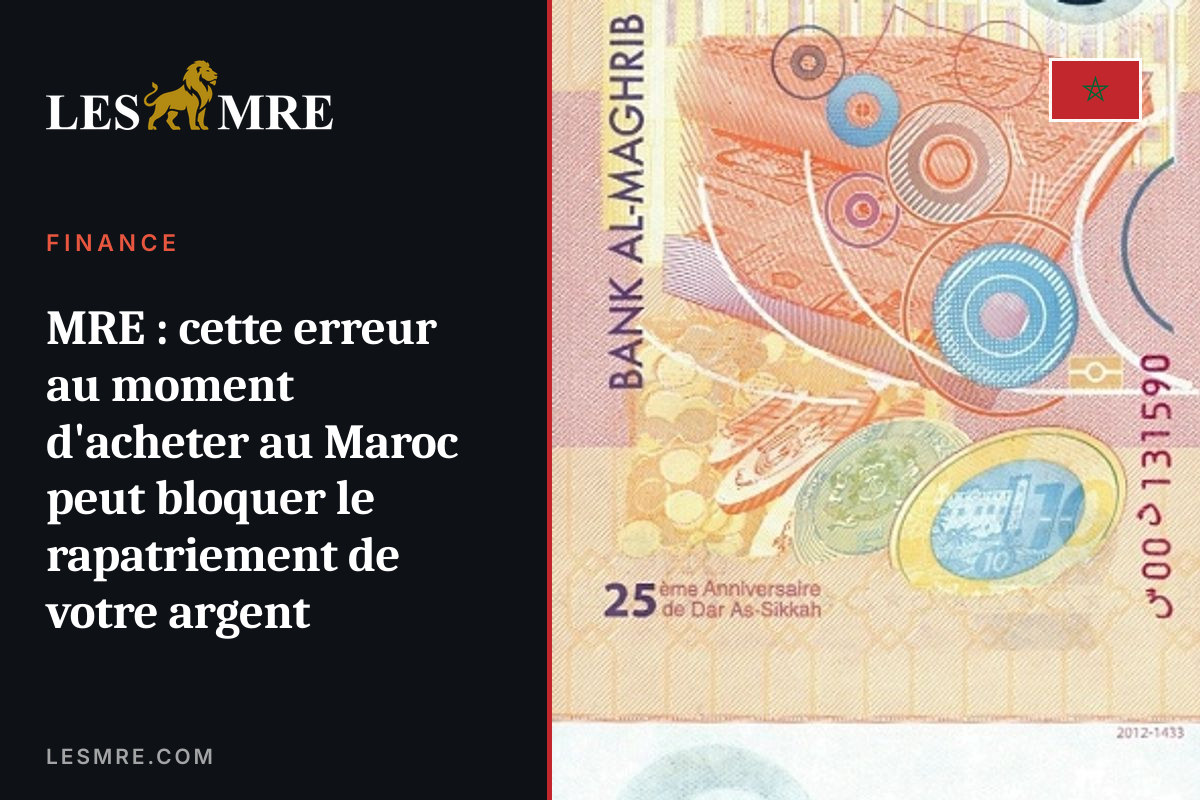
A foreigner or MRE investing in Morocco can only repatriate resale proceeds if the purchase was financed in foreign currency. The Exchange Office requires banking traceability from the outset; otherwise the transfer is blocked. Under Article 171 of the Exchange Instruction.
MRE: this mistake when buying in Morocco can block the repatriation of your money
A foreign national or an MRE who invests in Morocco may freely repatriate the proceeds of a resale, provided one decisive condition is met: proving that the transaction was financed in foreign currency. Article 171 of the 2026 General Foreign Exchange Operations Instruction guarantees the transfer of investment income as well as the proceeds from its disposal or liquidation, on condition that it was financed in foreign currency. The scheme applies to foreigners residing or not residing in Morocco as well as to Moroccans resident abroad. It covers, in particular, the creation of a company, the acquisition of shares, loans to a company, term deposits, but also the purchase of real estate and any work carried out on it, as detailed by the Office des Changes.
The mistake may consist of financing the acquisition from an ordinary dirham account, moving the funds without preserving their traceability, or paying without the bank being able to link the received foreign currency to the investment. In that case, the property obviously remains the buyer’s, but the proceeds of its resale no longer necessarily benefit from freedom of transfer.
Foreign individuals, whether resident in Morocco or not, as well as MREs, can avoid this difficulty by opening a foreign‑currency or convertible‑dirham account. Under Article 228 published by the Office des Changes, such accounts may receive transfers from abroad and be used to make payments in Morocco or abroad. The essential precaution must be taken at the financing stage. Funds intended for the purchase of a home or any other investment must arrive from abroad through the banking channel, accompanied by supporting documents that link the transfer to the actual payment.
The Office des Changes states that a non‑resident foreigner may place the sale proceeds in a “convertible term account”. The money then becomes transferable in four equal 25 % instalments: the first immediately, the remaining three on each anniversary date. This option is not, however, open to foreigners resident in Morocco nor to MREs. For the latter, sums arising from an investment that does not benefit from the convertibility regime must be deposited in an ordinary dirham account and are not freely transferable abroad.
The money is therefore neither confiscated nor unusable: its owner may spend or reinvest it in Morocco. It is the exit of the funds from the territory that becomes difficult, owing to the lack of an automatic guarantee of conversion and transfer.
Related articles

Related practical guides
Are you an MRE?
Join the platform and reach verified professionals in Morocco. Free.
Have a project in Morocco?
Find a LesMRE-verified expert to guide you through your steps.
Find an expert →