
Ryad Mezzour, investment minister: what changes for Moroccans abroad who want to invest in Morocco
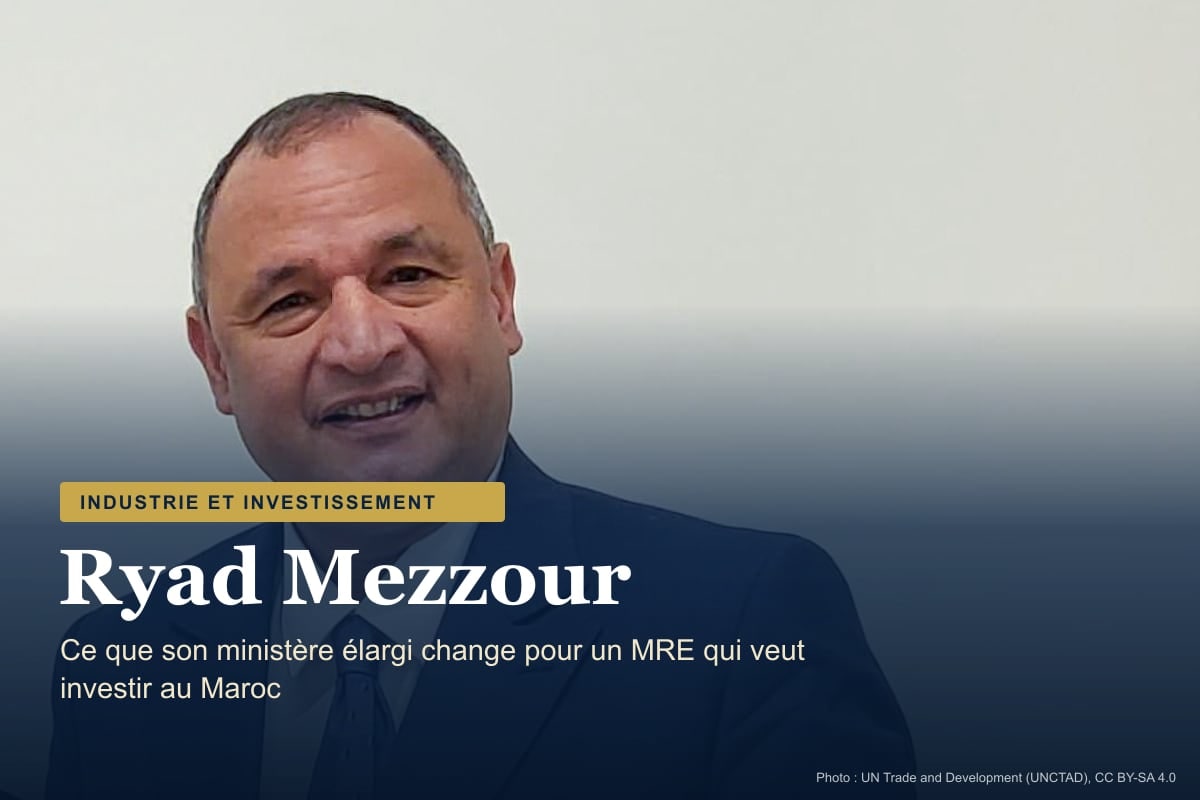
Reappointed on 16 October 2026, Ryad Mezzour adds Investment to Industry. His career from Zurich to Suzuki Maroc, five years of industry in figures, and what the Investment Charter offers Moroccans abroad: grants up to 30%, profit repatriation, MDM Invest.
In 1996, a young Moroccan graduated in mechanical engineering from the Swiss Federal Institute of Technology in Zurich. He joined ABB in Switzerland as a research engineer, then became a consultant at Deloitte. He lived what many Moroccans abroad live: studies and a first career far from Casablanca, where he had taken his baccalaureate at the Lycée Lyautey in 1989.
Thirty years later, Ryad Mezzour holds one of the portfolios most useful to the diaspora. Reappointed on 16 October 2026 in the government of Fatima Ezzahra El Mansouri, he becomes Minister of Industry, Trade, Investment and Economic Inclusion. Investment, previously handled by a minister delegate, now appears in his title. For a Moroccan abroad who wants to start a business or fund a project in Morocco, his ministry is now the one in charge.
Key points
- •An ETH Zurich engineer, former managing director of Suzuki Maroc, Industry Minister since October 2021.
- •Reappointed on 16 October 2026, with Investment and Economic Inclusion added.
- •The Investment Charter names Moroccans living abroad explicitly: those who invest in foreign currency can repatriate their profits with no limit on amount or duration.
- •The SME scheme funds projects from 1 to 50 million dirhams, with grants of up to 30%.
- •Moroccans abroad account for nearly 10% of national private investment.
An engineer trained in Zurich
Ryad Mezzour was born on 16 May 1971 in Rabat. After graduating from ETH Zurich in 1996, he worked in research and development at ABB, then in consulting at Deloitte. In 2003 he became managing director of Budget Maroc in Casablanca. He then worked at the Zellidja lead foundry company before running Suzuki Maroc from 2009 to 2013.
Alongside this, he was vice-president of the CGEM employers' confederation's Green Economy committee from 2012 to 2015, then chief of staff to the president of the Economic, Social and Environmental Council from 2013. In 2019 he became chief of staff to Industry Minister Moulay Hafid Elalamy. Two years later, on 7 October 2021, he succeeded him. He is married with two children.
Five years of industry in figures
He sums it up in one sentence, given to Finances News Hebdo in July 2026: "We have moved from subcontracting to sovereignty."
The official industry barometer figures, presented in October 2025, describe 2024:
- •898 billion dirhams in industrial turnover, up 9%.
- •90 billion dirhams in industrial investment, up 30%.
- •1,038,133 industrial jobs, 42,714 of them created in 2024.
- •The automotive sector: nearly 196 billion dirhams in turnover and more than 250,000 direct jobs.
In the automotive sector, local integration rose "from 30% at the start to nearly 70% today", according to the minister. In aeronautics, around 150 companies have at least one plant in Morocco, with 26,000 jobs. "Morocco no longer just assembles engine nacelles, it now produces the entire engine," he said in November 2025.
Industrial land followed. "At the start of my term in 2021, Morocco had 10,000 hectares of developed and equipped industrial zones. Today, that figure has reached 15,000 hectares," he explained in April 2026, with 7,000 more hectares planned. The project bank, which aims to replace imports with local production, listed 1,905 projects in April 2025, with 85% of the capital coming from Moroccan operators. And the "Made in Morocco" label was awarded to its first companies in May 2026.
What Investment means for you
The reference text is the Investment Charter, framework law No. 03-22, published in the Official Gazette in December 2022. Several of its articles directly concern Moroccans abroad.
Equal treatment (Article 2). The law sets out the principle of "equal treatment of investors whatever their nationality".
Repatriating your returns (Article 31). This is the article that names you explicitly. "Moroccan individuals established abroad" who invest in Morocco with foreign-currency financing benefit from a convertibility guarantee. It gives them "full freedom" to transfer their after-tax profits "with no limit on amount or duration", as well as the proceeds of a sale or liquidation, capital gains included.
The cap on grants (Article 16). Grants can be combined "up to 30% of the eligible investment amount".
Combining with regional aid (Article 6). Charter grants can be combined with regional schemes.
What falls outside the main scheme (Article 7). Agricultural projects come under their own laws. Projects "in the real estate and trading sectors" are not eligible for the main scheme's grants; the law announces "specific measures" for them.
Three entry points depending on project size
The SME scheme, the closest to a typical diaspora project. It became operational in November 2025. It is aimed at a company under Moroccan law, independent of large groups, with turnover between 1 and 200 million dirhams, for an investment of 1 to 50 million. It requires at least 10% equity and 1.5 permanent jobs per million invested. Three grants can be combined up to 30%: stable jobs up to 10%, a territorial grant which, according to Le360, reaches 10% or 15% depending on the zone, and a grant for priority activities. Applications are filed online only with the regional investment centre (CRI), and an agreement with the State is mandatory. Six weeks after launch, 89 projects had been approved for 1.28 billion dirhams. There is no specific rule for Moroccans abroad: you enter through a Moroccan company.
The main scheme, for projects of at least 50 million dirhams or creating at least 150 stable jobs. It includes a 5% sector grant for priority sectors: industry, tourism, digital, renewable energy and logistics.
Strategic projects, from 2 billion dirhams.
Tools designed for Moroccans abroad
MDM Invest, run by Tamwilcom, is separate from the Charter. It pays a grant of 10% of the project cost, capped at 5 million dirhams, with at least 20% equity. Applications go through the banks. Payment terms and eligible sectors should be confirmed with Tamwilcom. MDM Tamwil supplements bank credit with a loan of 1 to 5 million dirhams at 2.5% excluding tax.
The CRIs have opened units dedicated to diaspora project holders, in several languages. From 10 to 13 August 2026, a Moroccans of the World Investment Week was held in CRIs across the Kingdom. By July 2025, 59 projects led by Moroccans abroad had obtained the territorial grant, in 11 regions. A digital platform dedicated to Moroccans abroad was put out to tender in January 2026; its launch has not yet been confirmed.
The challenge: going beyond 10%
On 6 November 2024, His Majesty the King set the course: "it is inconceivable that their contribution to the volume of national private investment should be limited to 10%". The figures presented at the Tangier forum in May 2026 show the gap: your remittances exceeded 122 billion dirhams in 2025, but diaspora investment remains around 10% of private investment.
Ryad Mezzour now has industry and investment in the same ministry. In the same July 2026 interview, he said he wanted Morocco to be "not just a workshop, but a decision-maker". For Moroccans worldwide, the question is concrete: how many of them will become shareholders in this Morocco that produces.
Frequently asked questions
Who is Ryad Mezzour? An engineer who graduated from ETH Zurich, born in 1971 in Rabat, former managing director of Suzuki Maroc. Industry Minister since 2021, he was reappointed on 16 October 2026 with Investment added.
Which minister is in charge of investment in Morocco? Ryad Mezzour, Minister of Industry, Trade, Investment and Economic Inclusion since 16 October 2026.
Can a Moroccan abroad repatriate profits from an investment in Morocco? Yes, if the investment is financed in foreign currency. Article 31 of the Investment Charter guarantees the transfer of after-tax profits with no limit on amount or duration, as well as sale proceeds.
What support exists for Moroccans abroad investing in Morocco? Investment Charter grants, including the SME scheme of up to 30%, and Tamwilcom's MDM Invest, a 10% grant capped at 5 million dirhams.
Does a real estate project qualify for Charter grants? Not under the main scheme: Article 7 excludes real estate and trading, for which specific measures are announced.
Where should an investment project be filed? With the regional investment centre (CRI) of the project's region, online for the SME scheme.
Sources
- •Cover photo: Ryad Mezzour in Geneva, 22 October 2025, UN Trade and Development (UNCTAD), licence CC BY-SA 4.0; the cover image is shared under the same licence
- •Framework law No. 03-22 on the Investment Charter, Official Gazette No. 7152 of 15 December 2022
- •Ministry of Industry and Trade website (mcinet.gov.ma); TelQuel, Hespress, Le Brief and Morocco World News, 16 October 2026; Morocco World News, 8 October 2021
- •Le360: industry barometer (29 October 2025), industrial land (15 April 2026), project bank (15 April 2025), SME scheme (8 November 2025)
- •Finances News Hebdo, interview of 31 July 2026 and Investment Week (7 August 2026); Hespress, 3 November 2025 and 14 July 2025; TelQuel, 18 June 2025
- •La Vie éco, 5 and 14 January 2026; Infomédiaire, July 2024; h24info, 22 May 2026
- •Royal speech of 6 November 2024 (Finances News Hebdo, Le360); CCME and Hespress, Tangier forum, 22 May 2026
Related articles
Related practical guides
Are you an MRE?
Join the platform and reach verified professionals in Morocco. Free.
Have a project in Morocco?
Find a LesMRE-verified expert to guide you through your steps.
Find an expert →