
61 Moroccan “saboteurs” in Oran: what Algiers’ own photos really tell
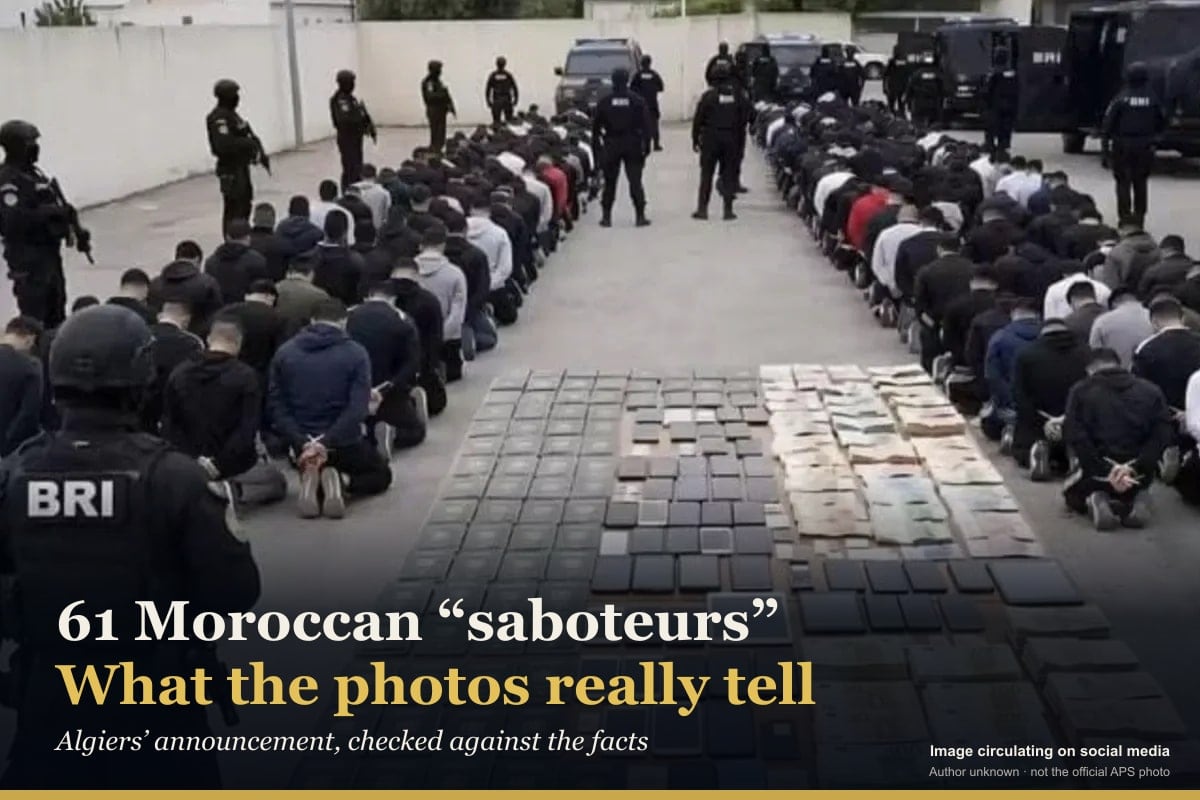
Three jet skis at the back of the official photo, a sign about migrant smuggling, no target. And a second image, with 300-euro notes that do not exist. What the photos of the 61 Moroccans in Oran really tell.
About sixty men stand packed together in a courtyard, in front of a building. Around them, officers from the BRI unit in black and their black 4x4s. In front, a table covered with passports, with a banner of the Oran police. And at the back, near the cars, three jet skis.
This is the official photo. Algeria’s state news agency APS released it on Sunday 11 October with a police statement: 61 Moroccans arrested in Oran, members of an “international Moroccan criminal network” described as “extremely dangerous”, who were preparing “acts of sabotage”.
Sabotage of what? The text does not say. With what? It mentions no weapon and no explosive. On whose behalf? Nothing either. The money seized, in dirhams and euros, does not even come with an amount.
A strange route for saboteurs
The official account fits in a few lines. The 61 allegedly flew to Tunis. They then crossed the border on foot, along the forest trails of El Kala, at Algeria’s far eastern edge. From there they supposedly drove across the whole country to Oran, at the other end. Among them, the police add, a former Moroccan army soldier.
Oran, precisely. Last May, police there arrested 67 Moroccans. They presented them at the time for what they appeared to be: people trying to reach Europe. Five months later, in the same city, the same profile has become a sabotage network. On the October photos, the sign still speaks of migrants.
Two photos, two stories
The jet skis are no detail. In Oran, they have been used for years for clandestine crossings to Spain. The Moroccan site Médias24 noticed something else on the official images: passports that “look new”, and a sign bearing the name of a unit fighting migrant smuggling and human trafficking.
A second image has since been circulating on social media, picked up notably by the site Akhbarona. The courtyard is not the same: white walls, no building. The men are no longer standing but kneeling, in two long rows, and there are about a hundred and twenty of them, twice as many. On the table, around a hundred passports and bundles of notes. Zoom in, and “300” can be read on green euro notes.
There is no 300-euro note. There is no 300-dirham note either: Bank Al-Maghrib has only ever issued 20, 50, 100 and 200-dirham notes, and three commemorative notes of 50, 25 and 20 dirhams.
This second image matches neither the place, nor the number, nor the scene of the official photo. No one knows who made it, and it proves nothing against Algiers. It only shows that, on this case, even the pictures contradict each other.
The fourth time in five years
August 2021. The forests of Kabylie burn, Algiers blames Morocco, then breaks off diplomatic relations on 24 August. September 2024: four Moroccans are accused of espionage in Tlemcen, a week before the presidential election. July 2026: four more are accused of planning to disrupt the legislative elections, and the army later broadcasts their “confessions”.
Each time, a loud announcement. Then nothing. To our knowledge, none of these cases has led to a public trial where the evidence was shown.
Rabat’s silence
In Morocco, no official reaction as of 14 October. A source in Rabat, quoted anonymously by Jeune Afrique, sums the case up in two words: “pure fabrication”. In its view, these men were simply trying to reach Europe through smuggling networks.
That silence has its reason. About 2,800 Algerians live in Morocco, according to the 2024 census. To our knowledge, none has ever been paraded in a police statement.
In Oran, 61 Moroccans are waiting to face a judge. They stand accused of a sabotage whose target, so far, no one knows.
Sources
- •DGSN statement relayed by the APS agency, 11 October 2026 (reported by TSA, Bladi, Hespress, Africanews).
- •Jeune Afrique, 12 October 2026, unofficial source in Rabat.
- •Official photo released by APS on 11 October 2026; Médias24, 12 October 2026 (passports and sign); Akhbarona, 12 and 13 October 2026 (image circulating on social media).
- •Bank Al-Maghrib, notes in circulation and commemorative notes (bkam.ma).
- •ObservAlgérie and Yabiladi, May 2026: 67 Moroccans arrested in Oran; Médias24, 2 September 2024; Bladi, July 2026.
- •High Commission for Planning, “Foreign residents in Morocco”, 2024 census, November 2025: 148,152 foreigners, 6% from the Maghreb, of whom 31.4% Algerian (LesMRE calculation).
Related articles
Related practical guides
Are you an MRE?
Join the platform and reach verified professionals in Morocco. Free.
Have a project in Morocco?
Find a LesMRE-verified expert to guide you through your steps.
Find an expert →