
Ceuta: Judge Tardón demands satellite images, Sánchez downplays naval incursion
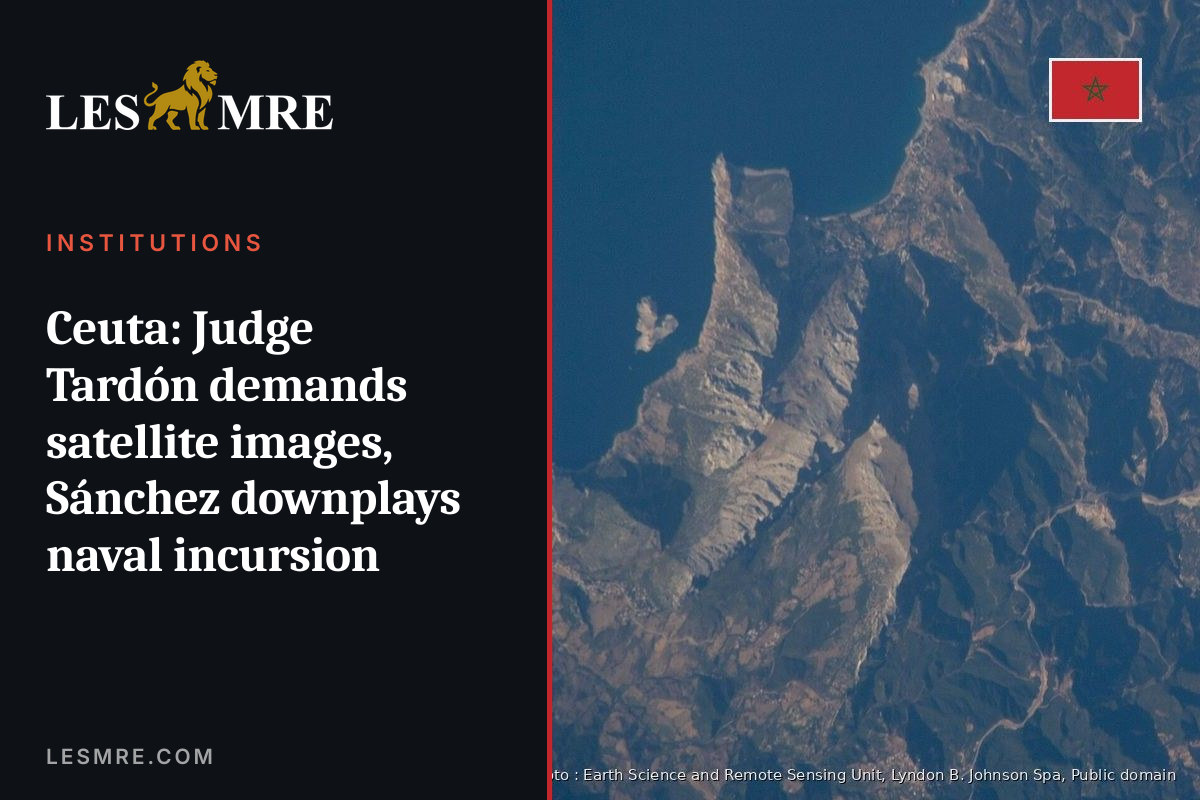
According to El Confidencial, Pedro Sánchez acknowledged the entry of the frigate 'Mohamed VI' into Spanish waters, calling it a 'specific' incident. Judge María Tardón's investigation, opened after a complaint by Iustitia Europa, targets 'management favoring' the migratory flow.
On 12 October, Prime Minister Pedro Sánchez acknowledged to journalists the entry of the frigate “Mohamed VI” into Spanish sovereign waters off Ceuta, which began on 30 July. He described the episode as a “one‑off” incident and reiterated that he had “no evidence to suggest that Morocco was involved in the massive influx” of migrants, according to El Confidencial’s 14 October edition. Two days earlier, the government spokeswoman had dodged three questions about the failure to inform Congress of this naval incursion, again reducing it to a “one‑off” event “despite the intervention of the Spanish Navy”, the same outlet reports.
The judicial inquiry seals the case and targets “management facilitating” the flow
The opening of the investigation by the Audiencia Nacional, confirmed on 7 September by Le Monde and El Mundo, stems from a complaint lodged by the organisation Iustitia Europa. In her order of 7 September, Judge María Tardón endorses the CENIF (National Centre for Immigration and Borders) report, which establishes a “clear and indisputable management facilitating the process from Moroccan territory”. The magistrate declares the Audiencia Nacional competent for offences committed abroad that have harmed territorial integrity (Article 2 of the Constitution), citing Sánchez’s description of the event as an “attack on the State”. Euronews, on 8 September, specifies that the inquiry targets offences against the peace and independence of the State, involuntary homicide, 84 dead according to the order, around 140 according to the overall tally, 83 of them in Spanish waters, and criminal organisation, the judge noting that “the use of migratory flows constitutes one of the methods employed in ‘hybrid warfare’ operations”.
The decision of 8 September identifies a five‑level structure. At the third level appear “members of the Moroccan security forces, in uniform or in plain clothes”, presented as the on‑ground organisers of the flow. “Some uniformed agents are alleged to have given directions to guide people attempting to cross the border and overcome obstacles up to the area near Fnideq beach and the water,” writes the judge, as quoted by Euronews. On 16 September, María Tardón ordered the handover of satellite, ground, maritime and aerial imagery for the period 20 July-7 August, requesting “as many satellite images as it holds” as well as “any video footage it may have obtained via its operational air, sea and land commands”, El Confidencial details. The request extends to all Defence intelligence centres (EMAD, CIFAS, Joint Cyber Command) and to risk alerts issued before the assault. On 29 September, the judge opened a sealed file to protect the investigation from leaks, citing indications of involvement by “persons holding high responsibilities in public institutions” and “links with individuals connected to foreign governments”.
The Spanish executive contradicts the hypothesis of Moroccan state involvement
Faced with these demands, Interior Minister Fernando Grande‑Marlaska denied on 7 September any proof of Moroccan intervention. “To date there is no element supported by a minimally logical, reasonable and objective fact of any intervention by Morocco or any other State, nor by any specific agent or person as the intellectual author of the Ceuta crisis,” he stated, according to El Mundo. This position contrasts with the judge’s order, which points to an “intent to attack the State” and with Sánchez’s own acknowledgment of a Moroccan military naval incursion. The investigation must also determine responsibilities on the Spanish side, notably “the deployment of adequate response measures on Spanish territory, in relation to the information and alerts concerning its possible occurrence”, El Mundo notes. A “extreme risk” alert had been issued on 29 July by the National Border Post Coordination Centre, forecasting a scenario of coordinated entries by swimming and fence‑breaching, Euronews recalls.
The inquiry continues under a regime of partial secrecy.
Sources
- •El Confidencial (elconfidencial.com), 14 October 2026
- •El Mundo (elmundo.es), 7 September 2026
- •Euronews (fr.euronews.com), 8 September 2026
- •Le Monde (lemonde.fr), 7 September 2026
Related articles

Related practical guides
Are you an MRE?
Join the platform and reach verified professionals in Morocco. Free.
Have a project in Morocco?
Find a LesMRE-verified expert to guide you through your steps.
Find an expert →