
Remittances from Moroccans abroad: 61.48 billion dirhams by end of June 2026, a new record, and what it means for your transfers
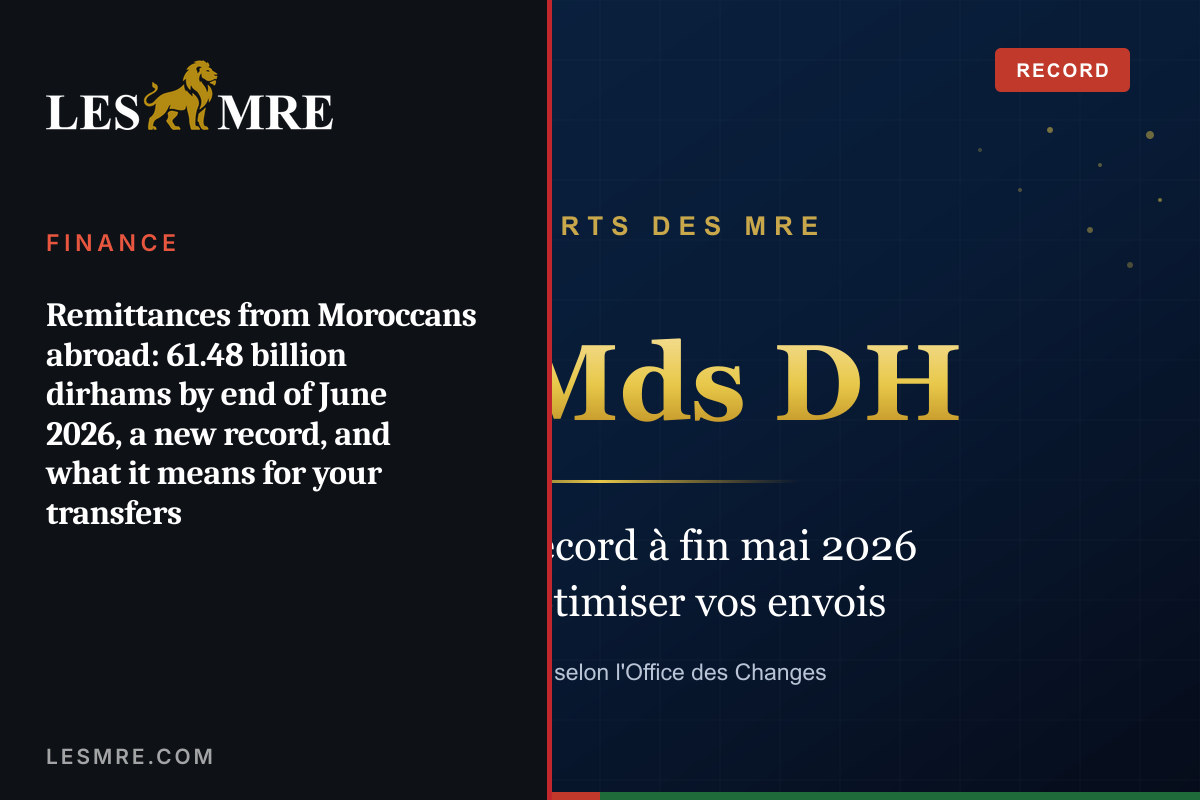
Remittances from Moroccans living abroad reached 61.48 billion dirhams by the end of June 2026, against 55.95 billion a year earlier. A 9.9% increase, or 5.53 billion dirhams more, according to provisional Office des Changes data. Beyond the figure, we look at what this volume changes for your transfers and how to compare the real cost of sending money.
A record that speaks volumes
The figures have just come in and they are telling. By the end of June 2026, remittances from Moroccans living abroad reached 61.48 billion dirhams, according to the Office des changes. A year earlier, over the same period, the total stood at 55.95 billion. The rise is clear: around 9.9% in a year. It is a new record, and it confirms a deep-seated trend.
Behind that number are millions of individual gestures. A transfer for the family, help with building work, a rent to cover, savings being repatriated. Every Moroccan abroad who sends money home is part of this total. And it is precisely because this flow is so large that it is worth asking yourself: am I sending my money in the smartest way possible?
What the record volume means for you
A level of remittances like this is not just a statistic for economists. It has concrete effects on the channels you use.
First, competition. When volumes rise, money-transfer players (banks, specialist operators, apps) compete for your transfer. That competition can work in your favour, with more aggressive offers on fees or the exchange rate. But you still have to compare, because not everyone cuts their margins of their own accord.
Then, the variety of channels. The market has grown a lot: alongside classic bank transfers and long-standing operators, digital solutions have multiplied. More choice means more chances to pay less, but also more risk of getting it wrong if you only look at the headline price.
Finally, traceability. A record official volume means more and more money going through declared, tracked channels. That is good news: traceable routes are safer, quicker to sort out if something goes wrong, and far easier to justify if one day you have to prove where the funds came from.
The true cost of a transfer: beyond the headline fees
This is the point many people miss. When you send money, the cost is not just the advertised fee. There are two components, and the second is often the heavier one.
- •The headline fees. This is the visible line: "transfer for 3 euros", "send with no fees". It is the part everyone looks at, which is exactly why it is sometimes played up to hide the rest.
- •The margin on the exchange rate. This is the hidden part. The operator applies an exchange rate less favourable than the real market rate, and pockets the difference. A "fee-free" transfer can easily cost you more than one with a fee but a good rate, simply because the rate applied is worse.
To compare two options honestly, do not look at the fees. Look at how many dirhams actually land in the Morocco account for the same amount sent. That is the only figure that really matters. Run the test with the same amount, on the same day, across two or three channels, and the ranking may surprise you.
A simple example to make it clear
Imagine you send the equivalent of 1,000 euros. A first operator advertises zero fees, but applies a rate that gets 10,600 dirhams to arrive. A second charges 5 euros in fees, but with a better rate you get 10,750 dirhams. The second, despite its visible fees, leaves you better off. Without working it out on the final amount received, you would have chosen the first thinking you had a good deal.
Applied to every transfer over a year, this reasoning quickly adds up to several hundred dirhams of difference. On a regular flow, the habit of comparing pays for itself very fast.
The practical habits to adopt
A few simple principles to send money better, without complicating your life.
- •Compare on the amount received, not on the fees. This is the golden rule. The only good indicator is how much arrives at the other end.
- •Favour traceable, declared channels. Banks, licensed operators, recognised apps. A tracked transfer is safer, better protected and easier to justify in case of a check or dispute.
- •Be wary of informal cash. Handing cash to an undeclared middleman to save a few dirhams is a real risk: no traceability, no recourse if something goes wrong, and potential complications proving the origin of the funds later. The small apparent gain is almost never worth the risk.
- •Group transfers where you can. If you multiply small transfers, the fixed fees pile up. A slightly larger transfer, less often, usually costs less overall, provided your family back home can manage the cash flow.
- •Watch the rate, not just the day you send. The exchange rate moves. On a large amount, sending one day rather than another can make a real difference. Without obsessing over it, keep an eye on it.
In short
With more than 50 billion dirhams transferred by the end of June 2026, up 9.9% in a year, Moroccans worldwide confirm their central role. For you, this momentum is good news: more competition, more choice and real chances to send money better. The one habit that changes everything is to compare on the amount actually received in Morocco, factoring in the exchange rate and not just the headline fees. And to stay on traceable channels, safer for you and for your family.
This article is provided for general information and does not constitute personalised financial advice.
Related articles
Related practical guides
Are you an MRE?
Join the platform and reach verified professionals in Morocco. Free.
Have a project in Morocco?
Find a LesMRE-verified expert to guide you through your steps.
Find an expert →