
Hantavirus 2026: What MRE Should Know Before Marhaba
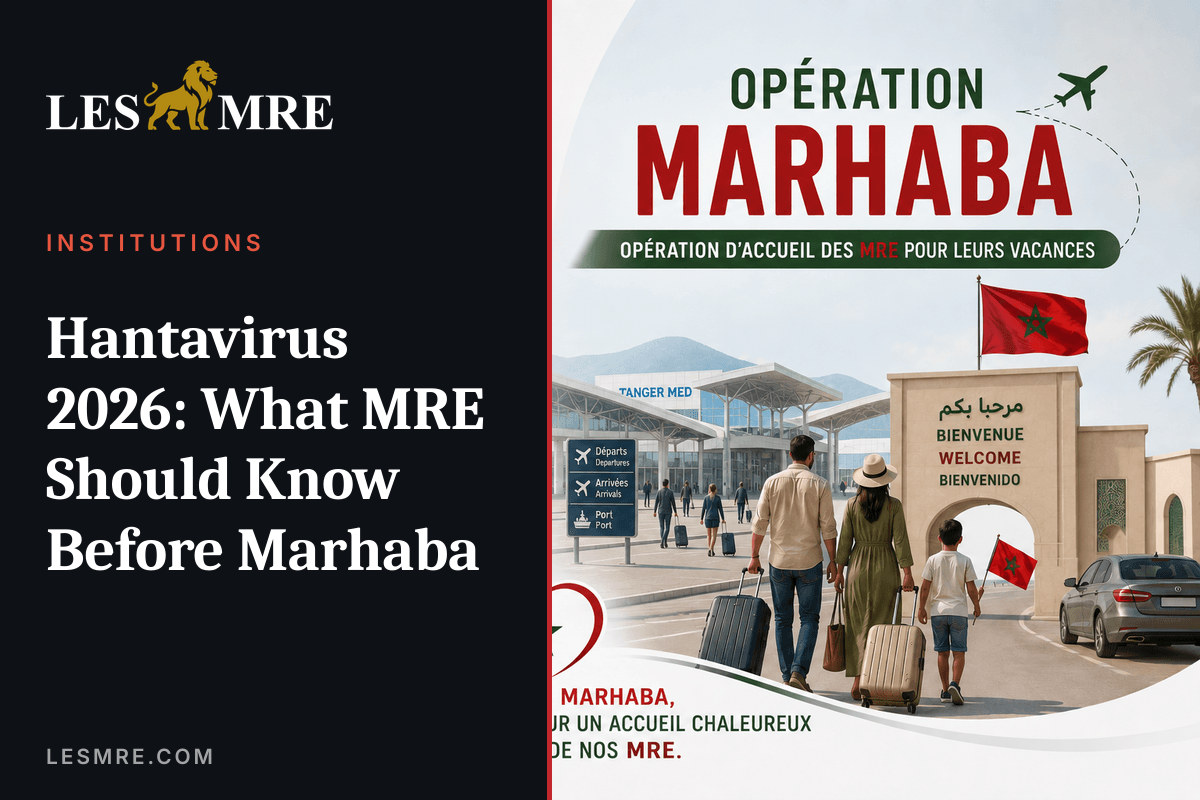
Hantavirus 2026 and Operation Marhaba: zero confirmed cases in Morocco, reinforced surveillance. The 5 essential prevention actions for MRE opening a family home closed for months, the health kit to pack, and what to do if symptoms appear.
Update, September 28, 2026: Operation Marhaba 2026 ended on September 15, 2026. This article describes the arrangements as they were announced before or during the operation. The review is here: Marhaba 2026: millions of Moroccan expatriates welcomed.
TL;DR
Hantavirus is back in global health news for 2026. As Operation Marhaba 2026 approaches (June 5 to September 15), many MRE are asking: should the trip and stay in Morocco be a concern?
Factual answer, no alarmism:
- •Zero confirmed cases in Morocco to date. The Ministry of Health and Social Protection has reinforced epidemiological surveillance at points of entry.
- •Hantavirus does not transmit human to human for most known strains (only specific South American strains transmit between humans).
- •Real risk for MRE mainly involves family homes closed 10 to 11 months in rural areas: opening, cleaning, and first summer stay.
- •Prevention boils down to 5 simple actions taking under 30 minutes per home.
This practical guide gives you the right reflexes before departure, on arrival, and during the stay. No reason to postpone your Marhaba, provided you apply basic precautions.
What exactly is Hantavirus?
Hantavirus is a family of viruses transmitted mainly by wild rodents (mice, rats, voles, field mice). Humans become infected through contact with:
- •Droppings, urine, or saliva of infected rodents
- •Inhalation of contaminated dust when sweeping a closed infested room
- •More rarely, through direct bite
| Key fact | Detail |
|---|---|
| Virus family | Hantaviridae (mainly Orthohantavirus genus) |
| Reservoir | Wild rodents |
| Main transmission route | Aerosols of contaminated dust |
| Human-to-human transmission | Nearly nonexistent (except South American Andes) |
| Incubation | 1 to 5 weeks (median 2 to 4 weeks) |
| Strains in Europe and North Africa | Puumala, Dobrava, Seoul |
Source: World Health Organization (WHO), European Centre for Disease Prevention and Control (ECDC), Centers for Disease Control and Prevention (CDC).
Which symptoms should I watch for after returning from Marhaba?
Two syndromes depending on the strain:
European and North African form (most probable for MRE): Hemorrhagic Fever with Renal Syndrome (HFRS)
- •Sudden fever above 38.5 degrees Celsius (101.3 F)
- •Severe headache
- •Muscle and lower back pain
- •Digestive issues (nausea, vomiting)
- •Decreased urine output after 4 to 7 days
- •Possible blurred vision
American form: Hantavirus Pulmonary Syndrome (HPS), rare outside the Americas.
If you experience these symptoms within 2 to 5 weeks of staying in a long-closed home or rural area, consult without delay and tell the doctor about your stay. Diagnosis is via serology (blood test) or PCR.
What is the real risk for an MRE in 2026?
Let's be factual. The MRE profiles concretely exposed are:
- •Families opening a home that has been closed more than 10 months in a rural or semi-rural area (countryside, douars, mountains, small-town outskirts)
- •MRE camping or bivouacking in the wild
- •MRE hunting or hiking in forest or agricultural zones
- •MRE renovating an old dusty family home or attic
Profiles with little or no exposure:
- •Stay in hotel or recent tourist rental
- •Stay in new urban apartment
- •Visit family in a year-round inhabited home
| MRE profile | Risk level |
|---|---|
| Hotel or tourist rental | Very low |
| Year-round inhabited urban apartment | Very low |
| Rural family home closed over 10 months | Moderate, prevention essential |
| Bivouac, camping, nature hiking | Moderate |
| Renovating attics, cellars, old garages | Moderate to high depending on dust |
The 5 essential prevention actions before and during Marhaba
Action 1: Before opening the family home, ventilate without entering
On arrival, do not enter immediately if the home has been closed for more than 6 months. Open all doors and windows wide. Let air circulate at least 30 to 60 minutes before entering. This simple ventilation removes potentially contaminated aerosols.
Action 2: Never dry-sweep a dusty room
The action that infects is dry-sweeping a room where rodents have lived. The dust raised contains infectious aerosols.
Instead:
- •Wet the floors first with a water plus diluted bleach mix (1 part bleach to 9 parts water)
- •Let it sit 10 minutes
- •Wipe with a wet mop
- •Put the mop in a sealed plastic bag, then in the trash
Action 3: Wear gloves and mask for major cleaning
To clean a long-closed home or dusty spaces (attics, cellars, outbuildings):
- •Rubber household gloves (not cloth)
- •FFP2 mask (buy before departure, 3 to 5 euros each)
- •Protective goggles if cleaning ceiling or attic
- •Avoid bringing young children into the room during cleaning
Action 4: Spot and eliminate rodent traces
Signs of presence:
- •Droppings (3 to 6 mm for mouse, 12 to 18 mm for rat)
- •Gnaw marks on bags, paper, baseboards
- •Characteristic urine smell
- •Holes in walls or baseboards
Actions:
- •Store all dry food in airtight hard plastic or glass containers
- •Plug holes with steel wool then cement or plaster
- •Set mechanical traps rather than poisons (risk for children and pets)
- •If visible infestation, hire a professional pest control service (40 to 100 euros per intervention in Morocco depending on city)
Action 5: Store food and water correctly
- •Water in sealed bottles, never water sitting in open basins
- •Bread, semolina, lentils, starchy foods: sealed jars
- •Trash bin with closed lid, emptied daily
- •Meal leftovers: refrigerator or freezer, never in open air overnight
What to pack in your MRE Marhaba 2026 health kit
Beyond Hantavirus, here is a reasonable and economical Marhaba health kit:
| Item | Why | Indicative cost |
|---|---|---|
| FFP2 masks (box of 10) | Cleaning closed home, dust | 5 to 15 euros |
| Disposable nitrile gloves (box of 100) | Any risky cleaning | 10 to 20 euros |
| Concentrated bleach | Disinfecting floors and surfaces | 2 to 4 euros |
| Hand sanitizer | Quick hand hygiene in car, ferry | 3 to 5 euros |
| Saline solution doses | Eyes, nose if irritation | 4 to 6 euros |
| Skin antiseptic (Betadine or equivalent) | Small wounds | 5 to 7 euros |
| Digital thermometer | Fever monitoring | 6 to 10 euros |
| Bandages, plaster, gauze | Small care | 5 to 8 euros |
| Paracetamol painkiller | Headache, fever | 3 to 5 euros |
| Simple antidiarrheal (no codeine) | Travel, food change | 4 to 6 euros |
| Sunscreen SPF 50 | Moroccan summer | 10 to 15 euros |
| Insect repellent (DEET 30 percent or more) | Rural areas in the evening | 8 to 12 euros |
Practical tip: buy these in your country of residence before departure. Brands are familiar and prices often more stable.
What to do if a symptom appears during the stay in Morocco?
No panic, but no trivializing either.
Step 1: Measure temperature
Fever above 38.5 Celsius (101.3 F) lasting over 24 hours, consult. Most Hantavirus symptoms appear after return (incubation 2 to 4 weeks), so fever during the stay is more likely another cause (heatstroke, gastro, ENT infection).
Step 2: Consult a doctor locally
Options:
- •Public health center (urgent and free for life-threatening emergencies)
- •Private medical practice (15 to 30 euros consultation depending on city)
- •Private clinics (30 to 60 euros consultation, exams on top)
- •Moroccan teleconsultation from your phone
Useful Morocco numbers:
- •National SAMU: 141
- •Police: 19
- •Civil Protection: 15
- •Pediatric emergencies (by city): vary, ask local pharmacy
Our complete guide on emergency care: Emergency medical care in Morocco for MRE.
Step 3: Mention your stay at any consultation upon return
Upon return to your country of residence, if you consult within 5 weeks for unexplained fever, tell the doctor:
- •That you are returning from Morocco
- •Approximate return date
- •Whether you cleaned a closed home
- •Whether you saw rodents or traces
This information immediately orients the diagnosis.
Marhaba 2026 and Hantavirus: should I change my trip?
Short answer: no. Operation Marhaba runs normally from June 5 to September 15, 2026, with its 26 reception sites (ports, airports, border posts) run by the Mohammed V Foundation for Solidarity.
No specific health restrictions have been announced by Moroccan or European authorities regarding Hantavirus as of this guide's publication date.
What changes for 2026:
- •Reinforced epidemiological surveillance at points of entry (factual information, no additional individual checks)
- •Health information posted at Tanger Med port and major airports
- •Increased availability of FFP2 masks in Moroccan pharmacies (verify on site)
To prepare your Marhaba calmly, also see our complete dossier: Operation Marhaba 2026: everything about MRE crossing.
Frequently asked questions
Is Hantavirus contagious between humans?
In almost all cases, no. European and North African strains (Puumala, Dobrava, Seoul) do not transmit between humans. Only certain South American strains (Andes virus) show person-to-person transmission, and these do not circulate in the Mediterranean basin.
Is a Hantavirus vaccine available for MRE?
No vaccine available in Europe or North Africa to date. Vaccines exist in South Korea and China for local strains (Hantavax), but do not cover European or Mediterranean strains. Prevention therefore relies on the 5 actions detailed above.
Does my travel insurance cover Hantavirus if I get sick in Morocco?
Yes in nearly all cases. Hospital admissions for infectious diseases are covered by standard travel insurance (premium credit cards, international mutuelles, specific contracts). Check before departure:
- •Hospitalization ceiling: 100,000 euros minimum recommended
- •Medical repatriation included
- •Possible advance of fees (without having to pay and then claim back)
- •COVID coverage still active (often included by default)
Should I cancel Marhaba 2026 as a precaution?
No. No health authority (WHO, ECDC, Moroccan Ministry of Health) recommends modifying travel to Morocco in 2026. The real risk for an MRE applying the 5 prevention actions above remains very low.
How long should I ventilate a closed home before entering?
Minimum 30 minutes, ideally 1 hour, windows and doors wide open. For rooms without windows (cellars, outbuildings), ventilate the adjacent room and create an air current. Do not turn on fan or air conditioning until you have completed the initial wet major cleaning.
Are children more at risk?
Children are not biologically more sensitive, but they touch the ground more, put hands in mouth, and play in dusty areas (attics, crawl spaces, overgrown gardens). Do the major cleaning before they arrive, or keep them busy elsewhere during cleaning.
Conclusion
Hantavirus 2026 is a health surveillance topic, not a reason to give up Marhaba. The MRE concretely exposed are those opening a family home closed for several months or doing dusty renovation. The 5 prevention actions take under 30 minutes per home and remove most of the risk.
LesMRE will follow the health situation through end of Marhaba 2026 and publish an update if the situation changes.
Official sources
- •World Health Organization (WHO): Hantavirus Fact Sheet, who.int
- •European Centre for Disease Prevention and Control (ECDC): Hantavirus surveillance Europe, ecdc.europa.eu
- •Centers for Disease Control and Prevention (CDC): Hantavirus Prevention Guidelines, cdc.gov/hantavirus
- •Ministry of Health and Social Protection of Morocco: sante.gov.ma (public health information)
- •Mohammed V Foundation for Solidarity, fm5.ma: Operation Marhaba 2026 program
Related articles

Related practical guides
Are you an MRE?
Join the platform and reach verified professionals in Morocco. Free.
Have a project in Morocco?
Find a LesMRE-verified expert to guide you through your steps.
Find an expert →