
Homologated kafala: France's Court of Cassation opens the door to French nationality
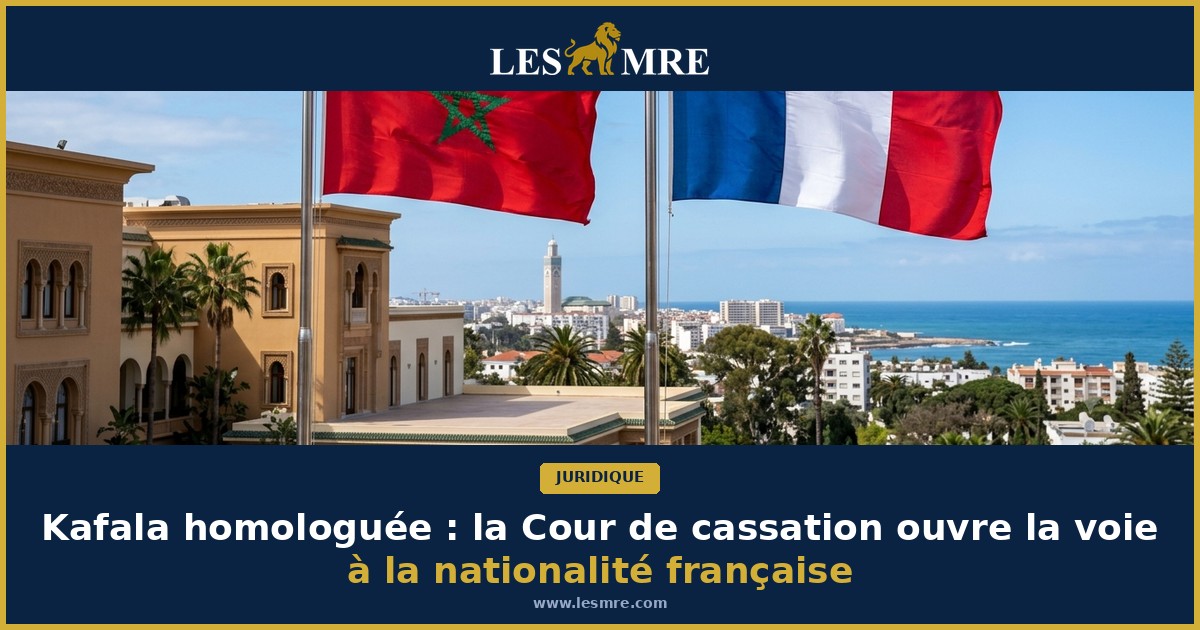
The Court of Cassation rules that a notarized kafala act in Morocco, homologated by a Moroccan judge after verifying the child's best interest, constitutes a judicial decision under Article 21-12 of the Civil Code, enabling acquisition of French nationality by declaration.
The Court of Cassation has just ruled on a question that has blocked cases for years. A kafala deed drawn up before a notary in Morocco and approved by a Moroccan judge, after verification of the child's best interests, does indeed constitute a court decision within the meaning of Article 21-12 of the Civil Code. The judgment of 21 January 2026 (First Civil Division, appeal no. 24-13.921, published in the bulletin) paves the way for the acquisition of French nationality by declaration for the children concerned.
What the Court of Cassation ruled
The First Civil Division was seized of a refusal by a director of court registry services to register a declaration of French nationality. A woman born in Morocco, taken in by a French couple in 2013 under a notarial kafala deed, had made this declaration upon reaching majority. The registry considered that the taking in did not result from a court decision. The Court of Cassation judges otherwise: the kafala deed, although notarial in origin, was incorporated into a complete judicial process. The Moroccan judge, sitting in a panel of three magistrates, verified the measure's conformity with the child's best interests, affixed his signature and the official seal. This judicial examination is sufficient to place the deed in the category of "court decision" required by French law.
The framework of Article 21-12 of the Civil Code
Article 21-12 allows a child to claim French nationality by declaration until majority, subject to four cumulative conditions: residing in France at the time of the declaration, having been taken in for at least three years, being raised by a person of French nationality, and that this taking in results from a court decision. The 2016 reform reduced the minimum duration from five to three years and removed the reference to French jurisdictions alone. The text now targets any "court decision" without territorial restriction. It is on this last condition that the litigation focused: does the approved notarial kafala fulfil this role? The Court answers in the affirmative provided the approval results from genuine judicial control of the child's best interests.
The distinction between judicial kafala and notarial kafala
Moroccan law knows two regimes. Judicial kafala applies to children declared abandoned by a court after an inquiry by the public prosecutor. It is pronounced by the guardianship judge according to a structured procedure with continuous monitoring. Notarial kafala, or adoula kafala, results from a deed drawn up by two adouls, public officers comparable to notaries, often within a family setting. It formalises the consent of the parents or holders of parental authority without a prior judicial declaration of abandonment or thorough inquiry. The circular of 22 October 2014 considers that notarial kafala, even approved by the judge responsible for notarial affairs, remains devoid of the extended effects of judicial kafala under Moroccan law, for lack of systematic monitoring of the execution of the taking in. The judgment of 21 January 2026 does not erase this difference of internal regime, but it sets a rule of recognition in French law: effective judicial approval changes the nature of the deed for the application of Article 21-12.
The scope of assimilation to a court decision
The assimilation operated by the Court is functional, not equivalent. Kafala does not create a bond of filiation, does not constitute adoption under French law, and does not confer inheritance rights. The judgment does not transform kafala into adoption. It simply recognises that, when a foreign judge has monitored the measure with regard to the child's best interests, it satisfies the legal requirement of "taking in by court decision". This reading avoids an overly restrictive interpretation that would have the effect of excluding situations where the child has been raised continuously and effectively by a French family for years. Legal certainty is thereby strengthened for the families concerned.
Effects on subsequent adoption
The child's acquisition of French nationality removes a major obstacle. Article 370-3 of the Civil Code prohibits the adoption of a minor foreign national if their national law prohibits this institution. Moroccan law prohibits adoption. As long as the child retains Moroccan nationality, adoption in France is blocked. Once French, this obstacle disappears: simple adoption becomes possible, subject to the consent of the legal representatives. The judgment does not create this right to adoption; it enables access to it by validating the prior step of acquiring nationality.
Frequently asked questions
Does a notarised kafala deed approved in Morocco allow the acquisition of French nationality?
Yes, when the approval results from a judicial process that has taken the child's best interests into account, the Court of Cassation assimilates this deed to a court decision within the meaning of Article 21-12 of the Civil Code.
What conditions must the approval meet to be recognised?
The deed must have been drawn up before a notary or adouls, then submitted to a foreign judge who has verified its conformity with the child's best interests, within the framework of a regular judicial procedure resulting in a signed and sealed decision.
Does kafala create a bond of filiation or constitute adoption in France?
No. Kafala does not create a bond of filiation, does not confer inheritance rights and does not constitute adoption under French law. The judgment operates a functional assimilation limited to the application of Article 21-12.
Does the acquisition of French nationality open the way to adoption?
Yes, indirectly. By becoming French, the child is no longer subject to the prohibition of Article 370-3 of the Civil Code which blocks the adoption of minors whose national law prohibits it. Simple adoption then becomes possible.
Finding a lawyer
This article sets out what the Court of Cassation ruled. It is not legal advice on any particular situation. Every kafala file has its own documents and its own history.
The LesMRE directory lists verified lawyers in Casablanca, Marrakech, Tangier, Fez, Tetouan, Mohammedia and Tinghir.
Browse the lawyers in the directory
Sources
Related articles

Related practical guides
Are you an MRE?
Join the platform and reach verified professionals in Morocco. Free.
Have a project in Morocco?
Find a LesMRE-verified expert to guide you through your steps.
Find an expert →