
Young French-Moroccans and school blockades: the real risks for arrested youth
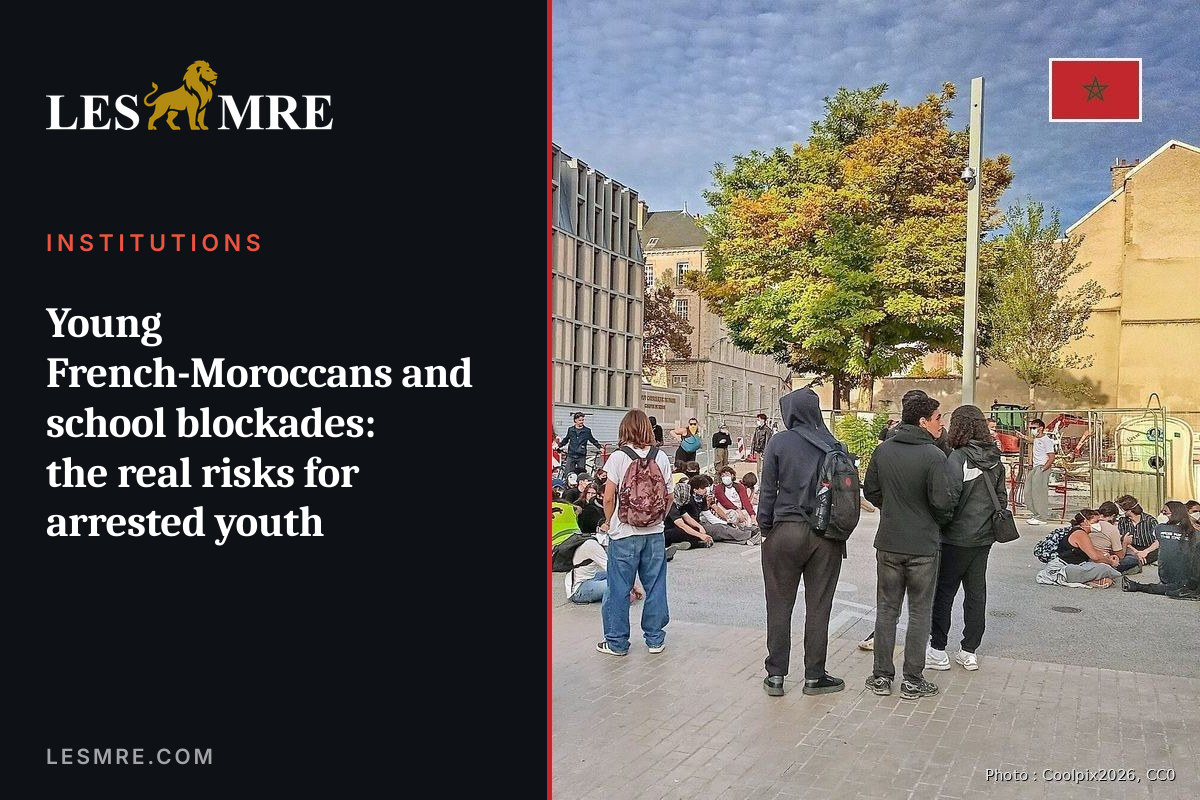
As of October 5, the Ministry of Justice recorded 5,060 custodial detentions related to the student movement, 87% of them minors. For a foreign minor, consequences can go beyond court: denial of residence permits, blocked naturalization, or ban from French territory for adults.
As of 5 October, the Ministry of Justice recorded 5,060 people held in police custody in connection with the student movement, 87% of whom were minors. Behind this figure lie families, many of them Moroccan families. What the law says deserves to be known, without being alarmist: for most young people, police custody ends without prison. But for a young person who does not have French nationality, the consequences can extend far beyond the courtroom.
Police custody: different rules depending on age
A minor under 10 years of age cannot be detained or placed in police custody. Between the ages of 10 and 13, only a period of detention (retenue) is possible, for an offence punishable by at least 5 years. From 13 to 18 years of age, police custody lasts 24 hours, extendable by a further 24 hours under certain conditions. A lawyer is mandatory for any minor, and parents are in principle informed within 3 hours (service-public.fr).
An adult can be held for 24 hours, extendable once. They have the right to a lawyer from the outset, to a doctor, to an interpreter, and they have the right to remain silent. A detail many are unaware of: a foreign national in police custody has the right to have their consulate notified, therefore the Moroccan consulate for a Moroccan national (Article 63-2 of the Code of Criminal Procedure).
What a minor risks
The French Code of Criminal Justice for Minors stipulates that a young person is presumed capable of discernment from the age of 13. Before the age of 13, no penalty is possible, only educational measures. After the age of 13, a prison sentence cannot exceed half of that for an adult.
A minor never goes through immediate appearance proceedings (comparution immédiate). They are judged in two stages: a hearing on their guilt, then, 6 to 9 months later, the sanction. Their convictions do not appear on the second part of the criminal record (bulletin n°2), which is consulted by certain administrative bodies and employers (Article 775 of the Code of Criminal Procedure).
A trace remains, however: the police database TAJ records any person implicated, even without a conviction. For a minor, this is in principle for 5 years. This database is consulted for certain jobs and during a naturalisation application (service-public.fr).
What an adult risks
Adults can be tried through immediate appearance proceedings. The maximum penalties provided for by the Penal Code give a sense of the offences:
- •remaining in an unlawful gathering after an order to disperse: 1 year;
- •participating in a group intent on violence or damage: 1 year;
- •insulting (outrage) a police officer: 1 year;
- •rebellion: 2 years, 3 years in a group;
- •damage in a group or with a concealed face: 5 years;
- •violence against a police officer: 5 years, and up to 7 years depending on circumstances;
- •arson: 10 years.
These are maximums: the sentences handed down are generally much lower. But for a foreign national, the maximum matters, as we will see.
For a young person of Moroccan nationality, what is added
As long as they are a minor, a young foreign national cannot be subject to an obligation to leave French territory (OQTF), nor to expulsion, nor to a ban on entering France (Articles L611-3 and L631-4 of the CESEDA, Article L121-1 of the Code of Criminal Justice for Minors).
The risk returns upon reaching adulthood, when they apply for their residence permit. The prefecture can refuse a permit on the grounds of a threat to public order. And since the immigration law of January 2024, a temporary or multi-year residence card can be refused or withdrawn from a foreign national "having committed acts" of violence against a police officer, a gendarme or an elected official. The text does not require a conviction (Articles L432-1-1 and L432-6-1 of the CESEDA). The administrative judge reviews these refusals: in October 2025, the Council of State ruled against a prefect who relied on minor acts committed during a young person's minority.
For an adult, the criminal judge can impose a ban on entering French territory for any offence punishable by at least 3 years (Article 131-30 of the Penal Code). The protection enjoyed by a foreign national settled in France since the age of 13 no longer applies for offences punishable by at least 5 years: damage in a group, violence against a police officer, arson (Article 131-30-2).
For naturalisation, a conviction of at least 6 months' imprisonment without suspension (ferme) closes the door (Article 21-27 of the Civil Code). Even without a conviction, the administration can reject or postpone an application. Children born in France who become French upon reaching adulthood are not affected by this obstacle.
For a dual French-Moroccan national, French law treats them as French: no OQTF, no expulsion, no ban on entering French territory. The loss of nationality is impossible for a French person by birth, and no offence related to demonstrations is among the four cases provided for a naturalised person (Article 25 of the Civil Code).
Equal before the law, not always before the police
The law is the same for everyone. However, practices have been measured. According to the Defender of Rights, in 2017, young men perceived as Black or Arab were approximately 20 times more likely than others to be stopped. Their new survey, published in June 2025, measures a 4 times higher risk of being stopped, and a 12 times higher risk of undergoing an "in-depth" stop: search, pat-down, taking to the station. The Council of State recognised in October 2023 that these discriminatory stops "are not limited to isolated cases". The Court of Cassation had already convicted the State for gross negligence in 2016.
Before the judge, the picture is more nuanced. The reference study by Fabien Jobard and Sophie Névanen finds no independent effect of origin on the sentence, once the offence, criminal record and mode of trial are taken into account. However, disparities occur upstream. According to a study by Virginie Gautron and Jean-Noël Retière cited by the Observatory of Inequalities, in comparable situations, people born abroad were directed to immediate appearance proceedings approximately 3 times more often and placed in pre-trial detention 4.8 times more often. The Ministry of Justice records 24.2% of foreigners among prisoners as of 1 April 2026, for 8.8% of foreigners in the population according to INSEE.
Parents could also pay
A bill known as "casseurs-payeurs" (vandals-pay) will be examined in the Senate from 27 October. It provides that any person having participated in a violent group is liable for the damage, up to 10,000 euros, without it being necessary to prove that they caused it themselves. It would also allow for the seizure of family allowance and housing benefits following a final conviction, including for the debt of a minor child. The text may still change in Parliament.
What families should know
The same arrest does not have the same weight for all young people. For a French young person, it generally leaves a trace in a database and, sometimes, a conviction. For a young Moroccan without French nationality, it can impact a residence permit, a naturalisation application, and their future in France.
Sources: Ministry of Justice, report of 5 October 2026; Légifrance (Penal Code, Code of Criminal Procedure, Code of Criminal Justice for Minors, CESEDA, Civil Code, version in force on 9 October 2026); service-public.fr; Council of State, 11 October 2023 and 10 October 2025; Court of Cassation, 9 November 2016; Defender of Rights, surveys published in 2017 and June 2025; Revue française de sociologie, 2007; Observatory of Inequalities; Ministry of Justice, response published in the Official Journal of 26 May 2026; INSEE; Senate, Bill No. 952 (2025-2026).
Related articles


Related practical guides
Are you an MRE?
Join the platform and reach verified professionals in Morocco. Free.
Have a project in Morocco?
Find a LesMRE-verified expert to guide you through your steps.
Find an expert →