
Belgium long-stay visa: 250 euros since July, and that is not the only fee
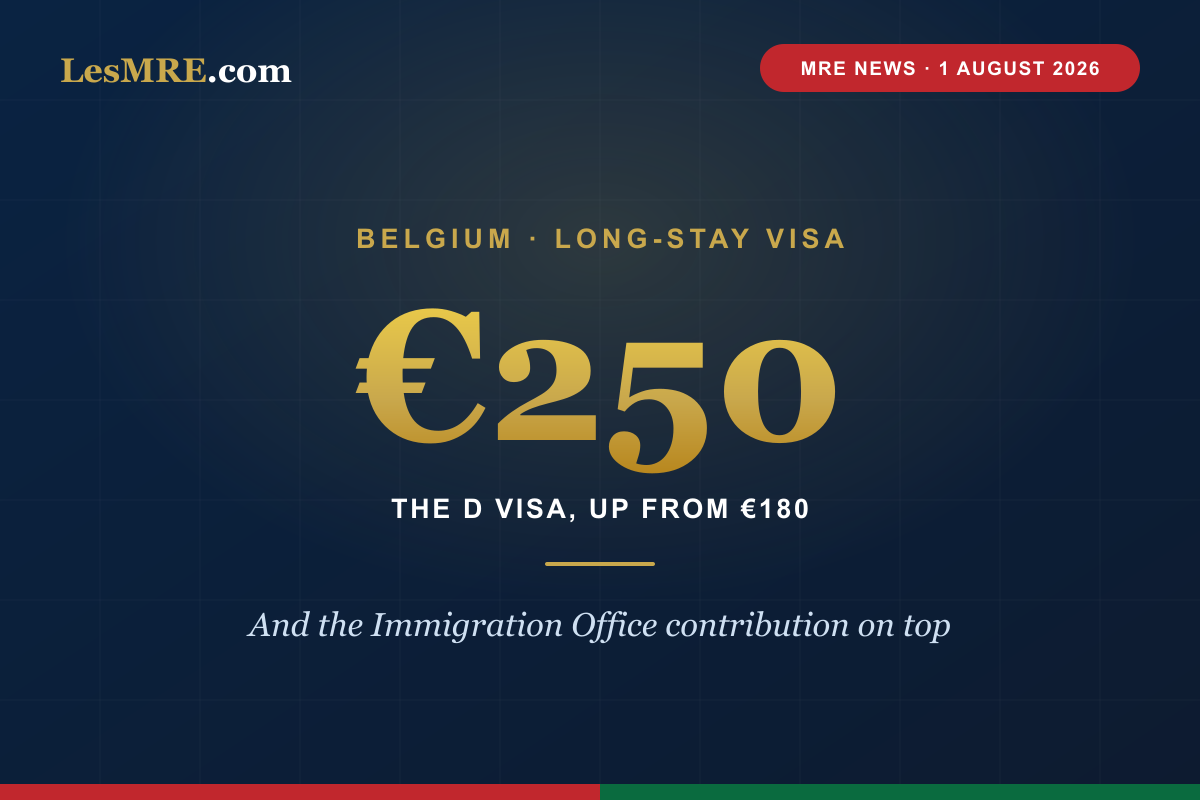
The D visa for Belgium went from 180 to 250 euros for all applications filed since 1 July 2026. On top of that comes an Immigration Office contribution ranging from 152 to 251 euros depending on the purpose. The real cost, purpose by purpose, and the exemptions.
A Moroccan filing a long-stay visa application for Belgium now pays 250 euros, up from 180. The increase applies to every file submitted since 1 July 2026.
The D visa covers stays of more than 90 days. It applies to studies, work, family reunification, marriage and legal cohabitation.
The trap of an appointment booked in advance
What counts is not the date the appointment was booked but the date the file is submitted. Someone who reserved a slot in May for a July appointment pays the new rate. No carry-over of the 180 euro rate is provided for earlier bookings.
The second fee, the one many discover too late
The 250 euros is not the total cost. A contribution is owed to the Immigration Office for handling the file, and the amount depends on the purpose of the stay. The figures below have applied since 1 January 2026.
| Purpose of stay | Contribution |
|---|---|
| Studies at a public higher education institution | €251 |
| Studies at a private institution, au pair, professional card, working holiday, private means, humanitarian grounds, marriage or legal cohabitation declaration | €242 |
| Family member of a Belgian, of a resident, or of a student | €218 |
| EU long-term resident, return authorisation | €202 |
| Single work permit, highly qualified worker, researcher, seasonal worker over 90 days, intra-group transfer | €152 |
| Applicant under 18 | €0 |
What it adds up to
| Situation | D visa | Contribution | Total |
|---|---|---|---|
| Student, public university | €250 | €251 | €501 |
| Student, private institution | €250 | €242 | €492 |
| Worker, single permit | €250 | €152 | €402 |
| Family reunification | €250 | €218 | €468 |
| Marriage or legal cohabitation | €250 | €242 | €492 |
These totals do not include the service fees charged by TLScontact, nor translations, legalisations and the documents to assemble.
Who does not pay the contribution
Several situations are exempt. Applicants under 18, scholarship holders, recognised stateless persons, refugees, family members of beneficiaries of international protection, Turkish nationals under the 1963 agreement, and EU citizens exercising free movement.
The scholarship exemption is worth checking before paying: a grant from a state or a recognised body can wipe 251 euros off a student file.
What it changes for a Moroccan family
For a student aiming at a Belgian public university, the administrative entry ticket has crossed the symbolic 500 euro line at 501 euros. That amount has to be paid before knowing whether the visa will be granted, since the contribution is not refunded if the application is refused.
It is the same movement as in France, where the resource threshold required of foreign students has just risen to 877.50 euros a month. Two countries, two mechanisms, the same direction. The comparison of the five thresholds covers France, Belgium, Germany, Spain and Canada with their official sources.
Frequently asked questions
I booked my appointment in June, why am I paying 250 euros? Because the rate that applies is the one in force when the application is submitted, not when the appointment was booked. An appointment held after 30 June 2026 falls under the new rate.
Are the contribution and the visa fee the same thing? No. The 250 euros is the visa fee. The contribution is a separate amount paid to the Immigration Office for handling the file, and it varies with the purpose of the stay.
Am I refunded if my visa is refused? The contribution is not refunded in case of refusal. Neither are the visa fees.
Does this also apply to short-stay Schengen visas? No. The D visa covers stays of more than 90 days. Short-stay visas fall under a different rate set at European level.
I hold a scholarship, do I still pay the contribution? Scholarship holders are among the exempt cases. Proof of the grant must be attached to the file.
Will these amounts change again? The contributions are indexed and reviewed periodically, the last revaluation dating from 1 January 2026. The visa rate was raised separately on 1 July 2026.
Sources
- •Immigration Office, Federal Public Service Home Affairs: visa fee rates and contribution grid in force on 1 January 2026
- •Federal Public Service Foreign Affairs, Foreign Trade and Development Cooperation: long-stay visa over 90 days
- •Royal Decree of 8 October 1981 on entry, residence, establishment and removal of foreign nationals
Related articles
Related practical guides
Are you an MRE?
Join the platform and reach verified professionals in Morocco. Free.
Have a project in Morocco?
Find a LesMRE-verified expert to guide you through your steps.
Find an expert →