
“Made in Europe”: as one door closes, Ryad Mezzour shows Morocco has others
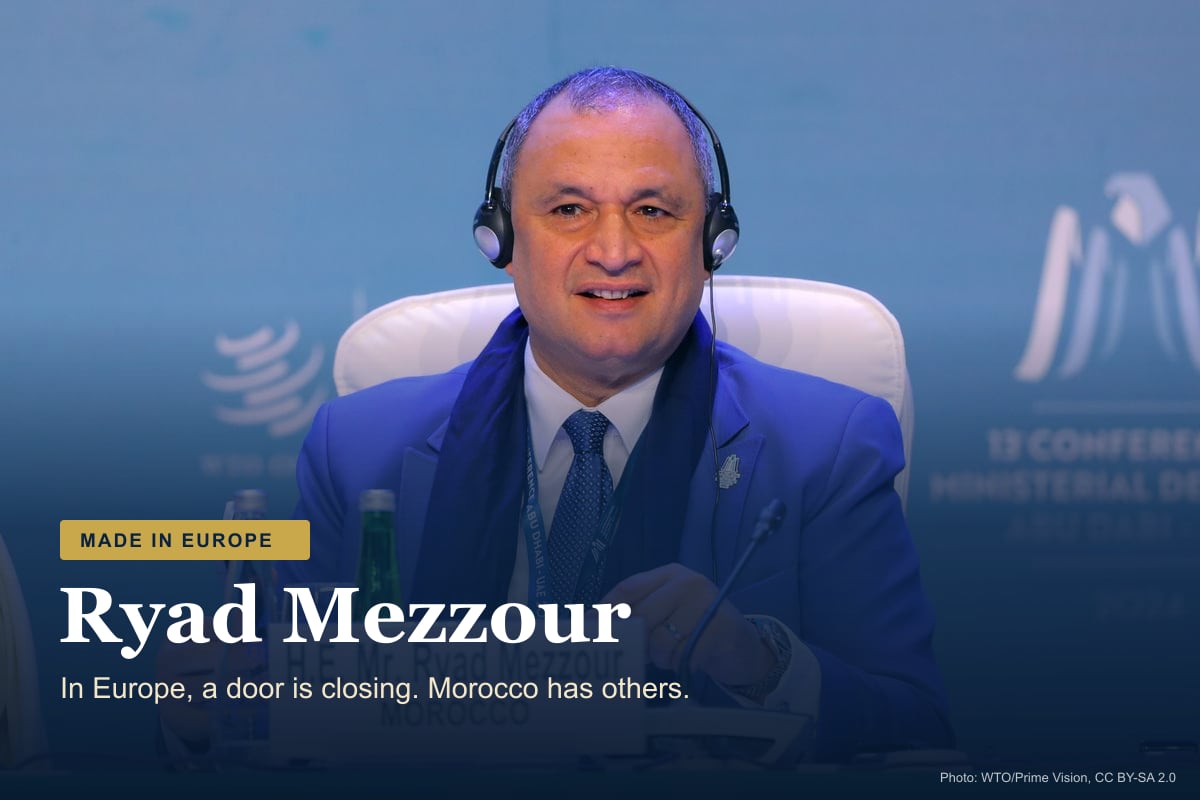
Paris and Berlin want to reserve European subsidies for electric cars assembled in the Union, leaving Morocco out. The Industry Minister answers with a frank diagnosis, figures, and a clear line: the Kingdom is a sovereign country, and Europe is not its only market.
In late June, in Kenitra, in front of manufacturers gathered at the automotive industrial competitiveness show, Ryad Mezzour gave a warning: “Whoever touches Morocco's interests will get a different answer from the one they get today.” Four months later, the warning makes full sense. This week, the weekly TelQuel headlines another of his phrases: excluding Morocco from the “Made in Europe” pact is “an aggressive act”.
He knows the subject. An engineer trained in Zurich and a former managing director of Suzuki Maroc, he has led Industry since 2021 and, since 16 October, Investment as well. The car industry, the Kingdom's leading export sector, is his home ground.
What the Franco-German deal says
On 15 October 2026, on the margins of a European summit, France and Germany agreed on a definition of the “Made in Europe” car. From 2028, to be bought with public money or supported by a subsidy, an electric or plug-in hybrid car would have to be assembled in Europe, with at least 70% of the value of its components, excluding the battery, of European origin. The United Kingdom could qualify through an exemption. Morocco and Turkey could not.
This text is not a law. The other member states and the European Parliament still have to decide, and Reuters, quoted by Bladi, does not expect a final version before early 2027. The European Commission's proposal, presented on 4 March, in fact opened the label to countries linked to the Union by a free trade agreement, a category that covers Morocco through its Association Agreement.
A frank diagnosis
On 10 November, before the Productive Sectors Committee of the House of Representatives, the minister hid nothing from the members. Over the past eighteen months, he explained, several projects expected in Morocco have been redirected to Europe. The effects may not show in the figures for five years, even though the indicators remain good: according to the Office des Changes, car exports reached 132.1 billion dirhams at the end of September, up 14.3% year on year.
Saying this while everything is going well means choosing to prepare the country rather than reassure it. The minister sees it as a test for the national economy and calls for all its forces to mobilise.
Facts against suspicion
Part of the European debate rests on an accusation: that Morocco serves as a gateway for Chinese products. Ryad Mezzour answers with figures. Of the 6 billion dollars of Chinese investment announced in Morocco, 1.2 billion has actually been committed. Over ten years, China has invested 160 billion dollars in Europe itself.
And the Moroccan plants? “The million vehicles that Morocco is able to produce each year come out of plants controlled by European carmakers,” he points out, as quoted by LesEco. Renault in Tangier, Stellantis in Kenitra. Morocco ships nearly 400,000 cars a year to the Union, all of European brands, while Chinese brands have sold more than 800,000 in Europe.
Several open doors
The minister's answer is a plan, set out as early as June in Kenitra. First, markets: bring Europe's share of car exports down from around 80% to under 60% by 2030. “It has never been so urgent for all, and for each one of you, to diversify your markets,” he told manufacturers. The European market accounts for 10 to 12 million vehicles; the world market, 90 million, with Africa, the Middle East, Mexico and Brazil.
Next, the plants: bring their level of robotisation up to German standards, then to the best Chinese standards. Then the brands: bring out Moroccan brands able to win in Morocco, among its neighbours and as far as Europe.
The Kingdom also holds cards that Europe does not. In Kenitra, Africa's first battery gigafactory is coming into service. And the minister asks a simple question: where will Europe's battery plants find their phosphate, cobalt or manganese, if not in Morocco? This strategy, he explains, is part of the vision of industrial sovereignty driven by His Majesty King Mohammed VI.
Nothing is settled in Brussels
Morocco is not alone in defending its plants. On 1 July, the European Automobile Manufacturers' Association (ACEA), whose members include Renault, Stellantis, Volkswagen and BMW, asked that investments already made in Morocco be preserved by the future regulation. The rules in question also apply only to electric and plug-in hybrid vehicles supported by public money, which for now spares most of Morocco's production, still combustion or mild hybrid.
In June, the minister said he was “convinced that reason will prevail” in the negotiations with Brussels. His line has not changed: negotiate with Europe, the Kingdom's leading partner, without depending on its decision alone. That is the position of a sovereign country.
Read also: Ryad Mezzour, investment minister: what changes for Moroccans abroad who want to invest in Morocco
Sources
- •TelQuel, issue 1201, 13 to 19 November 2026 (headline of the interview with the minister)
- •LesEco.ma, “Industrie : préférence européenne, électrochoc national”, 12 November 2026
- •La Relève, 11 November 2026, and Hespress English, 10 November 2026 (hearing of 10 November at the House of Representatives)
- •H24info, 30 June 2026 (Kenitra speech)
- •The North Africa Post, 6 June 2026 (answer to European criticism of Chinese investment)
- •Hespress, 2 July 2026 (ACEA position)
- •EUobserver, 16 October 2026; L'argus, 27 October 2026; Bladi.net, 17 October 2026 (Franco-German deal)
- •Euronews, 4 March 2026; Le360 English, 1 August 2026 (European Commission proposal)
- •Quotations translated from French by LesMRE
- •Cover photo: Ryad Mezzour on the sidelines of the WTO's 13th Ministerial Conference, Abu Dhabi, 25 February 2024, WTO/Prime Vision, licence CC BY-SA 2.0; the cover image is shared under the same licence
Related articles
Related practical guides
Are you an MRE?
Join the platform and reach verified professionals in Morocco. Free.
Have a project in Morocco?
Find a LesMRE-verified expert to guide you through your steps.
Find an expert →