
Moudawana reform: what Moroccan men are saying
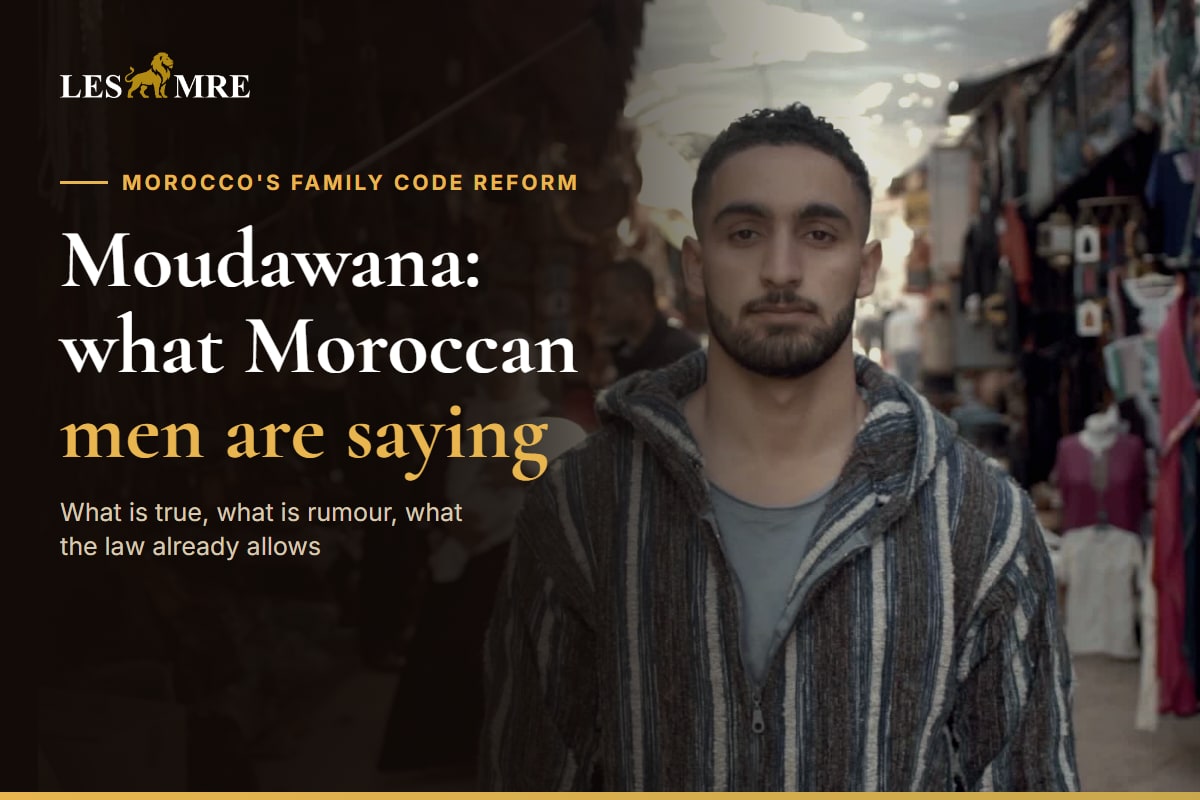
He pays for the home, the car, almost everything. She keeps her salary. Since the Moudawana reform was announced, many Moroccan men ask the same question: is marriage becoming a risk for the husband? What is founded, and what is only a rumour.
Since the main lines of the reform were announced in December 2024, part of Morocco's men have been worried. On social media, in families, among single Moroccans abroad, the same question keeps coming back: is getting married becoming a risk for the man? Here is what these voices say, what holds up, and what is only a rumour.
First, where the text stands
There is no new Moudawana yet. As of October 15, 2026, no bill has been filed in Parliament, and the 2004 Family Code remains the only law that applies. The measures announced and their timeline are covered in our article Moudawana reform 2026: 8 key changes for Moroccans abroad.
So the concerns are about proposals. Not about a law.
What men object to
New rights for the wife, unchanged duties for the husband
This is the argument heard most often. The reform recognises the wife's work at home as part of the couple's assets, lets a mother keep custody when she remarries, and gives her legal representation of the children. Yet the husband keeps every one of his duties: the dowry, housing, and nafaqa (maintenance) during the marriage.
Child support stays with the father alone. The current code is clear: the mother only pays if the father cannot (article 199). None of the announcements changes that.
When the wife works
Many men draw a line between two situations. For a wife who stays at home, protecting her rights at divorce seems fair to them. For a wife who works, much less so.
Their reasoning: her salary remains hers, and custom expects her to contribute little to household costs. At divorce, though, the husband would pay the divorce compensation (mut'a) and all of the child support, without the wife's income ever entering the calculation. For mut'a, the judge looks at how long the marriage lasted, the husband's means and the reasons for the divorce (article 84). Not the wife's salary.
How many couples does this concern? In 2025, fewer than one Moroccan woman in five was working or looking for work (19%, against 68.5% of men, according to the High Commission for Planning). Among women graduates aged 25 to 59, the share rises to 33.9%. The situation exists and it grows with education, but it remains a minority.
The sorest point: each spouse's money
Take a couple where both work. It is the scenario many men describe.
The husband brings the home, often a car. He pays the dowry, then the rent or the mortgage, the groceries, the bills, the children's school. That is the rule of Islamic law and of custom: household costs are his. His wife works too. Her salary stays hers, and custom asks her for a small contribution, sometimes none. Plenty of men would not even dare to suggest a real 50/50 split of expenses: it is still frowned upon.
Ten years go by. Because the husband pays for almost everything, she has been able to save. Maybe buy a flat, or a plot of land, in her own name.
Then comes the divorce. What men object to fits in one sentence: her assets stay hers, while part of his can be claimed.
What the law says, precisely:
- •Each spouse keeps their own assets. Whatever the husband owned before the marriage is not shared (article 49).
- •For assets bought during the marriage, the wife can claim part of the husband's by proving what she contributed. The reform adds that her work at home counts as a contribution.
- •What none of the announcements says is the reverse: that the household costs paid by the husband, which allowed his wife to save, count as a contribution to the assets she bought. In law, those costs are the husband's obligation (nafaqa), not an investment.
There is no automatic split and no 50/50 in the announcements. But the imbalance these men describe is real: the wife's work at home is recognised, the husband's money that kept the household running is not.
The children
Men's groups active online, such as the "Red Pill" movement, were already asking in 2023 that guardianship stay with the father and that custody be shared equally, so the father is not reduced to paying (L'Observateur, October 6, 2023). The reform gives legal representation to the mother who has custody. For some fathers, the fear is of counting for less in their children's lives after a divorce.
Marriage itself
The scholar Ahmed Raïssouni, former president of the International Union of Muslim Scholars, summed up this concern on December 25, 2024. In his view, the new rules weigh on the man before the marriage, during it, and after a divorce. Young people may turn away from it, while single life and relationships outside marriage come with no obligations. He added, ironically, that women might end up paying a large dowry to persuade a man to marry them (Akhbarona).
Researcher Abdallah Lahjaoui makes the same point with figures. Morocco already has fewer births: 1.97 children per woman in 2024, against 2.5 in 2004, below the replacement level. People marry later and more stay single. In his view, the reform could reinforce that trend (Al3omk, December 29, 2024).
In our conversations with single Moroccans abroad, two reactions keep coming back: getting married, but with a contract on the assets, or no longer wanting to marry at all.
What is only a rumour
"More than 2,300 weddings cancelled." The figure spread at the end of December 2024. The National Body of Adouls (traditional notaries) denied it: its president, Bouchaïb Fadlaoui Idrissi, called the figures false and pointed out that these were only proposals (L'Observateur, December 27, 2024).
"The ex-wife will receive maintenance for life." False. After a divorce, the ex-wife's nafaqa ends with the 'idda, the waiting period of about three months, unless she is pregnant. What continues is child support.
"Assets will be split 50/50." Nothing in the announcements says so, as explained above.
The other side of the debate
Women's associations find the reform too timid: it leaves inheritance untouched and barely changes polygamy. The Democratic Association of Moroccan Women considers it too close to a conservative consensus (Akhbarona, January 9, 2025). Lawyer Najat Baqqali pointed out that this is not a new code but a set of proposals, designed for the family's interest and not for women alone.
Preacher Younes Rihane, for his part, notes that young people's fear of marriage existed well before the reform (Le Site info). The cost of a wedding and of housing, and job insecurity, weigh too.
What the law already allows
Three tools have existed since 2004, and few couples know them:
- •A contract on the assets (article 49). Signed alongside the marriage certificate, it sets out how assets bought during the marriage will be divided: home, car, savings. Adouls must inform the future spouses about it.
- •Conditions in the marriage certificate (articles 47 and 48). The spouses can write commitments into it, for example each one's share of household costs.
- •The dowry. The law sets no amount. Custom is what drives the figures up.
Islamic law accepts conditions in marriage. A contract is therefore contrary neither to the law nor to religion. It simply has not become a habit yet.
What remains open
The final text has not been written. When it reaches Parliament, members will be able to amend it. One point sits at the heart of men's concerns and no announcement has settled it: whether the wife's income will count when calculating mut'a and child support.
For a specific situation, whether custody, divorce or inheritance, a Moroccan family lawyer can tell you what the current code provides. The verified lawyers in the LesMRE directory can be reached through the site's messaging.
Sources: Akhbarona (December 25, 2024 and January 9, 2025), Al3omk (December 29, 2024), L'Observateur (October 6, 2023 and December 27, 2024), Hespress (September 30, 2023), High Commission for Planning via Hespress (2025 activity rate), Le Site info, Family Code (Law 70.03, articles 47, 48, 49, 84, 199). Published on October 15, 2026.
Related articles


Related practical guides
Are you an MRE?
Join the platform and reach verified professionals in Morocco. Free.
Have a project in Morocco?
Find a LesMRE-verified expert to guide you through your steps.
Find an expert →