
Auto-entrepreneur, SARL or CFC status for an MRE in 2026: which structure to choose?
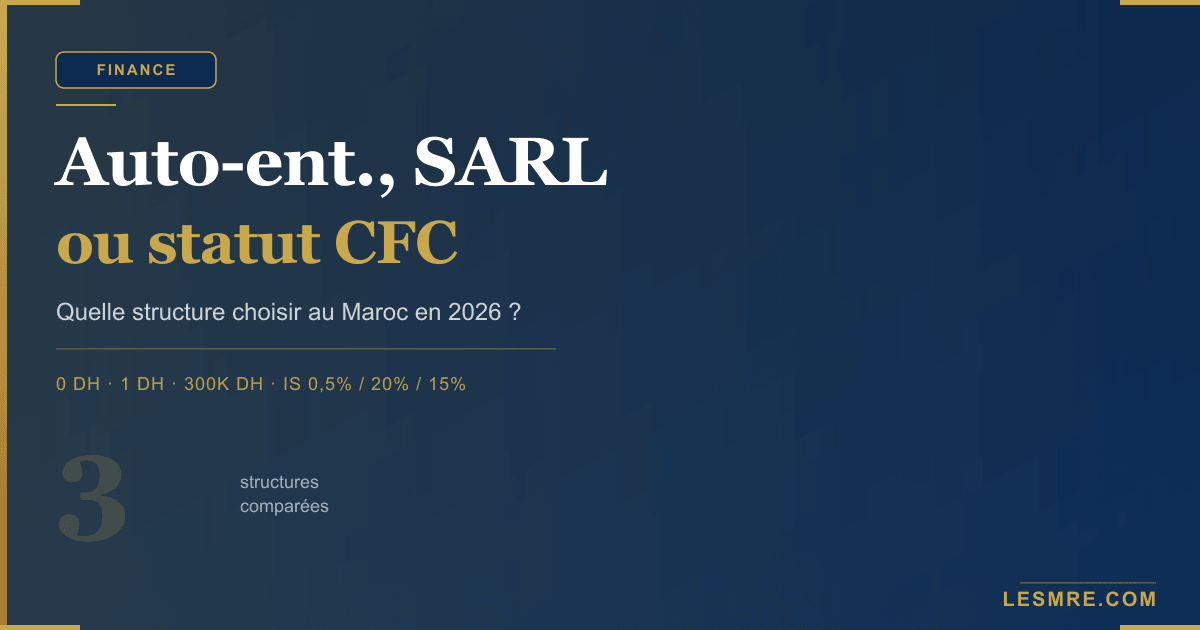
Minimum capital of 0, 1 dirham or 300,000 dirhams? Tax rate of 0.5 %, 20 % or 15 %? Turnover ceiling or no ceiling? The choice of Moroccan legal structure determines an MRE project's profitability for the first 5 years. 2026 numerical comparison and decision tree to choose without mistakes.
Minimum capital of 0, 1 dirham or 300,000 dirhams? Tax rate of 0.5 %, 20 % or 15 %? Turnover ceiling or no ceiling? The choice of Moroccan legal structure determines an MRE project's profitability for the first 5 years. 2026 numerical comparison and decision tree to choose without mistakes.
Why this question keeps coming up
It is the question MREs ask most when launching in Morocco: "Do I start as auto-entrepreneur, SARL, or aim straight for CFC status?". Three different answers depending on the profile, and a wrong initial choice typically costs 6 to 18 months of delay plus a few thousand dirhams in restructuring.
This comparison takes the three most relevant structures for a 2026 MRE, auto-entrepreneur regime, standard SARL, and Casablanca Finance City status, and tests them on the criteria that matter: setup cost, taxation, ceilings, aid eligibility, banking image, administrative complexity.
Synthesis comparison table
| Criterion | Auto-entrepreneur | SARL | CFC Status |
|---|---|---|---|
| Minimum capital | 0 MAD (individual) | 1 MAD symbolic | 300,000 MAD paid-up |
| Legal form | Individual | Company (SARL/SARL-AU) | Company (SARL or SA) with special status |
| Turnover ceiling | 200,000 MAD services / 500,000 MAD commerce | None | None |
| 80,000 MAD per client rule | Yes (above = reclassification) | No | No |
| Taxation | Flat IR 0.5 % commerce / 1 % services | IS 20 % (SME) or 35 % (turnover > 100M) | IS 15 % on export earnings, 20 % on rest |
| VAT | Exemption below thresholds | Depends on turnover | Depends on activity |
| Minimum contribution | None | 0.5 % of HT turnover, min 3,000 MAD/year | Same as SARL |
| Withholding on dividends | N/A (no dividend) | 15 % to non-residents | 0 % with CFC exemption |
| IR for expatriate executives | N/A | Standard IR scale | 20 % flat for 10 non-consecutive years (2026 Finance Act) |
| Setup time | 24-72 hours | 3-7 days via CRI | 45 days (CFC validation) + 48h company creation |
| Setup cost | 100-200 MAD | 1,500-3,000 MAD | 5,000-15,000 MAD (CFC + company) |
| Investment Charter eligibility (30 % grant) | No | Yes if invest > 1.5M MAD | Yes |
| MDM Invest eligibility (10 % grant) | No | Yes | Yes |
| Mandatory pro bank account | Recommended | Yes | Yes |
| Accounting | Simplified ledger | Full accounting + OEC expert | Full accounting + annual audit |
| Banking / pro client image | Weak | Medium | Very strong |
When to choose auto-entrepreneur?
The auto-entrepreneur status is ideal for starting out. Conditions are strict but benefits immediate. Reference: the 2026 article on auto-entrepreneur status details 2026 Finance Act novelties.
Target profile
- •Solo freelancer (consultant, developer, designer, trainer) with projected turnover < 200,000 MAD/year
- •Small independent merchant with projected turnover < 500,000 MAD/year
- •MRE wanting to test a Moroccan market before investing heavily
- •Seasonal or complementary activity to a job abroad
Limits to know absolutely
- •80,000 MAD per client rule: if more than 80 % of turnover comes from a single client, possible reclassification as disguised employee
- •No recoverable VAT: VAT-bearing purchases are borne by the auto-entrepreneur
- •No access to public procurement in most tenders
- •No Investment Charter grant nor MDM Invest
- •Limited image: large companies and banks favour SARLs
Recommended switch
As soon as turnover approaches 80 % of ceiling or a structuring investment becomes necessary, switch to SARL. The transition is legal: liquidate the auto-entreprise and create the SARL, ideally with a chartered accountant to ensure tax continuity.
When to choose SARL?
The SARL is the pivot structure for most MRE projects. Reference: Setting up a company in Morocco from abroad.
Target profile
- •Activity with projected turnover > 200,000 MAD/year
- •Several partners or management of a real estate portfolio (family SCI)
- •Investment project between 500,000 and 5 million dirhams
- •B2B activity needing banking and client credibility
- •Wish to repatriate dividends to country of residence
Decisive advantages over auto-entrepreneur
- •No turnover ceiling
- •Limited liability to share capital
- •Investment Charter access if investment > 1.5M MAD (grant up to 30 %)
- •MDM Invest access: 10 % grant of invested amount for MREs residing abroad for at least 3 years
- •France-Morocco tax convention applicable: 15 % withholding on dividends with French tax credit
Annual cost to anticipate
- •Minimum IS contribution: 3,000 MAD/year minimum even without activity
- •OEC chartered accountant: 3,000 to 8,000 MAD/year for standard SARL
- •Office domiciliation (if non-resident): 300 to 800 MAD/month
- •Pro bank account: 50 to 200 MAD/month depending on bank
Annual minimum total: between 8,000 and 18,000 MAD in fixed costs, to integrate in profitability projections.
When to aim for CFC status?
Casablanca Finance City status is the premium structure for MREs operating internationally. Reference: Free zones and CFC for MRE, 2026 tax guide.
Target profile
- •International services company (finance, tech, consulting, engineering) with African client base
- •MRE senior executive in a multinational wanting to benefit from 20 % flat IR regime
- •Multi-jurisdiction patrimonial holding seeking exemption on non-resident dividends
- •African subsidiary of an international group seeking a regional management structure
Cumulative conditions
- •Minimum 300,000 MAD paid-up capital (vs 1 MAD for classic SARL)
- •Predominantly international activity: no local retail, no pure Moroccan B2C
- •Real substance: offices at CFC (Twin Center, CFC Boulevard), at least 5 full-time executive employees first year
- •Complete application file (business plan, 3-year projections, motivation letter) to
guichetunique@cfca.ma, decision within 45 days
Decisive advantages over standard SARL
- •IS 15 % on export earnings (vs 20 % standard)
- •Withholding tax exemption on dividends paid to non-resident shareholders
- •20 % flat IR for 10 years for expatriate executives (2026 Finance Act reform: those 10 years can now be non-consecutive)
- •Currency freedom on international flows
- •Premium image with international partners
Annual cost to anticipate
- •Minimum IS, chartered accountant, mandatory CFC annual audit (15,000 to 30,000 MAD/year)
- •CFC rents: 150 to 250 EUR/sqm/year in dedicated buildings (Twin Center, CFC Boulevard)
- •Salaries of minimum 5 executives (CFC executive payroll is heavy but partially deductible)
Annual minimum total: from 800,000 MAD with a 5-executive team and CFC premises.
Quick decision tree
- •
Starting alone, projected turnover < 200,000 MAD, no public procurement need? → Auto-entrepreneur. Near-zero cost, simple, reversible.
- •
Projected turnover > 200,000 MAD or multiple partners or banking credibility need? → SARL. The standard for 80 % of MRE projects.
- •
Predominantly international activity with non-Moroccan client base and annual budget > 1 million MAD? → CFC status. Tax premium and image justify investment.
- •
Industrial exporter investment > 5 million MAD with > 25 jobs? → SARL in Tanger Med or Kenitra ZAI with Charter grant application. Not CFC because activity is productive, not service.
- •
Rental real estate portfolio in Morocco? → SCI or standard SARL. Not auto-entrepreneur (real estate excluded) nor CFC (incompatible).
Mistake not to make
The most frequent: starting as auto-entrepreneur when the project is clearly SARL-sized. It is tempting due to initial cost, but later tax reclassification can result in adjustment with late-payment interest. Conversely, aiming straight for CFC without market validation is risky: 300,000 MAD blocked capital and 5 salaries to pay each month without sufficient turnover quickly kills cash flow.
The most solid type of journey for an MRE who wants to test then scale: auto-entrepreneur 12 months → SARL beyond 150,000 MAD recurring turnover → CFC application from 3 million MAD international turnover. Three steps, three budgets, and each transition brings new tax advantages without skipping a step.
Related articles

Related practical guides
Are you an MRE?
Join the platform and reach verified professionals in Morocco. Free.
Have a project in Morocco?
Find a LesMRE-verified expert to guide you through your steps.
Find an expert →