
Relocating your Gulf company to Morocco in 2026: what is actually possible (and what is not)
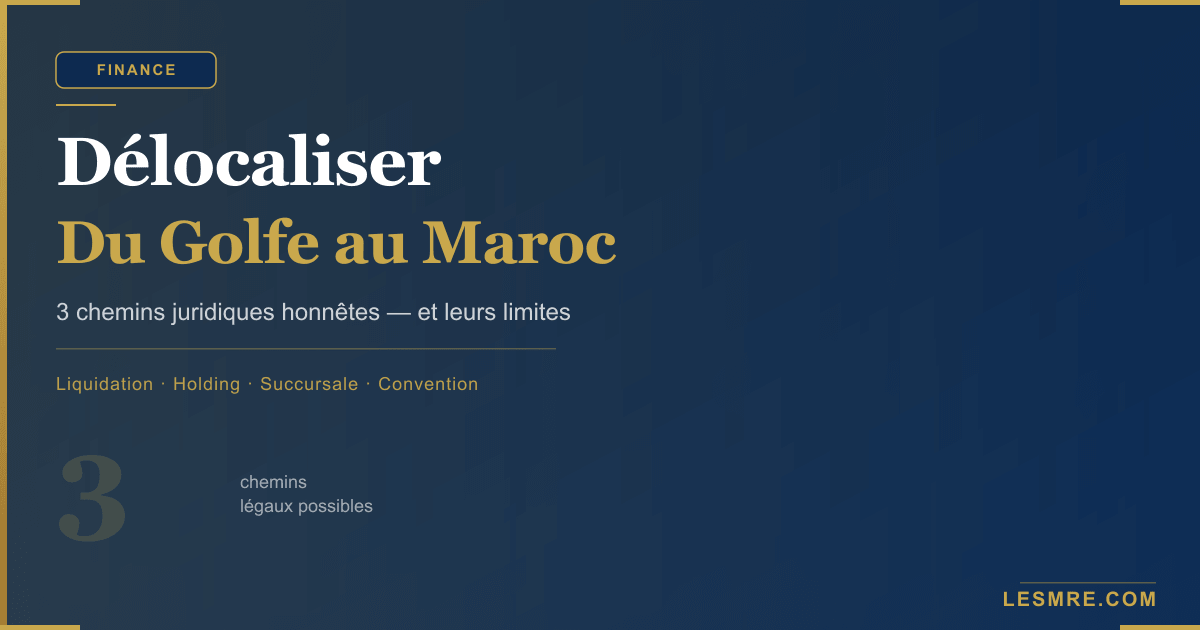
Morocco does not allow inbound redomiciliation of foreign companies. To transfer activity from Dubai, Abu Dhabi or Doha to Casablanca, three distinct legal paths exist: liquidation and new incorporation, Moroccan acquisition holding, or branch opening. Procedure, tax treatment and pitfalls for MREs in 2026.
Morocco does not allow inbound redomiciliation of foreign companies. To transfer activity from Dubai, Abu Dhabi or Doha to Casablanca, three distinct legal paths exist. Procedure, tax treatment and pitfalls for MREs in 2026.
The false evidence: you do not "transfer" a company from the Gulf to Morocco
The first thing to know, and that no general article states clearly, is that Moroccan law does not authorise inbound redomiciliation. A company incorporated in Dubai (DIFC, JAFZA, mainland), Abu Dhabi (ADGM) or Doha (QFC) cannot become a Moroccan company while keeping the same legal entity. This is a major difference with the UAE, which has accepted inbound redomiciliation since 2021.
For an MRE entrepreneur who wants to leave the Gulf in 2026, three distinct legal paths actually exist, each with its own taxation, lead times and limits.
Path 1, Gulf liquidation + new Moroccan company
The simplest and most used route by MRE-led SMEs.
Step 1, Clean liquidation of the Emirati company
A liquidation in Dubai (mainland) or a free zone generally takes 2 to 5 months depending on jurisdiction. Steps: extraordinary general meeting noting dissolution, liquidator appointment, publication in two local newspapers, settling debts and receivables, final audit, filing of closing minutes, cancellation of trade licence and work permits. Cost: typically 5,000 to 15,000 AED depending on zone.
Step 2, Incorporation of a Moroccan SARL
The Moroccan SARL can be set up in 72 hours to 7 working days via the Regional Investment Centres' portal, with a symbolic capital of 1 dirham. The MRE can be sole shareholder and non-resident manager. Full details: Setting up a company in Morocco from abroad.
Pros
- •Clean break: no inherited debt, no legal ambiguity
- •Brand-new Moroccan capital, hence direct access to MRE Invest schemes and the Investment Charter
- •Ability to fully reformulate corporate purpose and governance
Cons
- •Loss of trading seniority (useful for tenders, banking references)
- •Liquidation gain taxation in the Gulf depending on local rules (typically nil in UAE but to be checked in Qatar and Saudi Arabia)
- •If client contracts are ongoing on the Dubai side, they must be transferred or renegotiated
Path 2, Moroccan holding that buys out the Emirati company
The path favoured by entrepreneurs who want to keep the Dubai entity alive (to serve a Gulf market) while moving value back to Morocco.
Mechanics
A new holding company is created in Morocco, usually as an SA or SARL with more substantial capital (often 100,000 to 500,000 dirhams). This holding buys 100 % of the Emirati company shares via a transfer protocol valued by an independent expert. The Dubai shares become an asset on the Moroccan holding's balance sheet.
Tax articulation
The 1999 Morocco-UAE tax convention provides for elimination of double taxation. Dividends repatriated from the Dubai subsidiary to the Moroccan holding benefit from exemption under detention conditions (typically 10 % of capital over 12 months minimum). If the holding obtains Casablanca Finance City status, those dividends can be exempted from withholding tax on the Moroccan side when redistributed to non-resident shareholders.
Pros
- •Continuity of Emirati activity for existing contracts
- •Gradual and tax-optimised cash repatriation
- •Possibility to structure several subsidiaries (Dubai, Casablanca, later a third jurisdiction) under one holding
Cons
- •Higher structuring cost (40,000 to 150,000 dirhams for full setup with business lawyer and chartered accountant)
- •Heightened tax authority scrutiny on intragroup operations (transfer pricing, management fees agreements)
- •CFC status for holdings requires real Moroccan substance: offices, team, documented governance
Path 3, Moroccan branch of the Emirati company
The lightest but also most limited solution.
Mechanics
The Emirati company opens a branch in Morocco, registered with the Trade Registry with a legalised and apostilled extract of the foreign registry. The branch has no separate legal personality: it is an extension of the Dubai company on Moroccan territory.
Pros
- •Quick setup (4 to 8 weeks)
- •No need to liquidate the Dubai company
- •Simplified accounting
Cons
- •Subject to Moroccan corporate tax on profits realised in Morocco (standard rate 20 % to 35 %)
- •No access to CFC status nor to the Investment Charter grant (reserved for Moroccan-law companies)
- •Unlimited liability of the Dubai company on branch acts
- •Less credible image with Moroccan banks and clients than a true subsidiary
Which path for which profile?
| MRE profile | Recommended path | Main reason |
|---|---|---|
| Solo freelancer / consultant in Dubai | Path 1 (liquidation + SARL) | Simplicity, minimal cost |
| International services SME Abu Dhabi | Path 2 (holding) with CFC application | Gulf contract continuity + Africa base |
| Industrial exporter Jebel Ali | Path 1 + Tanger Med ZAI implementation | Charter grant + 5-year IS exemption |
| Salaried executive in Dubai contract | Path 1 on employer side, negotiate CFC transfer | 20 % flat tax 10-year expat status |
| Multi-jurisdiction patrimonial holding | Path 2 with lawyer support | Global tax optimisation |
Three pitfalls to avoid
- •
Underestimating Gulf liquidation duration. A Dubai mainland liquidation can take 5 months if all work permits are not cancelled upstream. Launching the new Moroccan company in parallel is possible, but operational overlap must be documented to avoid abuse qualification.
- •
Confusing CFC status and Charter grant. CFC status grants reduced 15 % corporate tax on export earnings and a flat income tax for expatriate executives. The Charter's investment grant is a cash subsidy up to 30 % of invested amount. Both are cumulable under conditions but do not cover the same scope.
- •
Neglecting the Morocco-UAE tax convention. This 1999 convention sets precise rules on intragroup royalties, interests and dividends. Poor structuring can result in 30 % taxation instead of 0 % on certain flows. A Moroccan tax lawyer specialised in international conventions is essential beyond 5 million dirhams of consolidated turnover.
Realistic timeline for a 2026 relocation
For an MRE starting the process today, here is the average expected timeline:
- •Month 1: Gulf + Morocco tax audit, path choice, document preparation
- •Month 2: Moroccan company incorporation (Path 1) or holding (Path 2)
- •Months 3 to 5: Dubai liquidation (Path 1) or share buyout (Path 2)
- •Months 4 to 7: operational transfer of contracts, key teams, bank accounts
- •Months 6 to 9: if Charter or CFC application, instruction and convention signing
- •Months 9 to 12: full ramp-up of Moroccan activity
Gulf-Morocco relocation is not a simple administrative transfer. It is a structuring corporate project that warrants the support of a Moroccan business lawyer registered with the bar, an Order-registered chartered accountant, and ideally a Gulf-side tax advisor for the exit phase. Under those conditions, the total structuring cost remains well below the tax and operational gains observed over 24 months.
Related articles

Related practical guides
Are you an MRE?
Join the platform and reach verified professionals in Morocco. Free.
Have a project in Morocco?
Find a LesMRE-verified expert to guide you through your steps.
Find an expert →