
Morocco-UAE tax convention: what Dubai-based MREs need to know in 2026
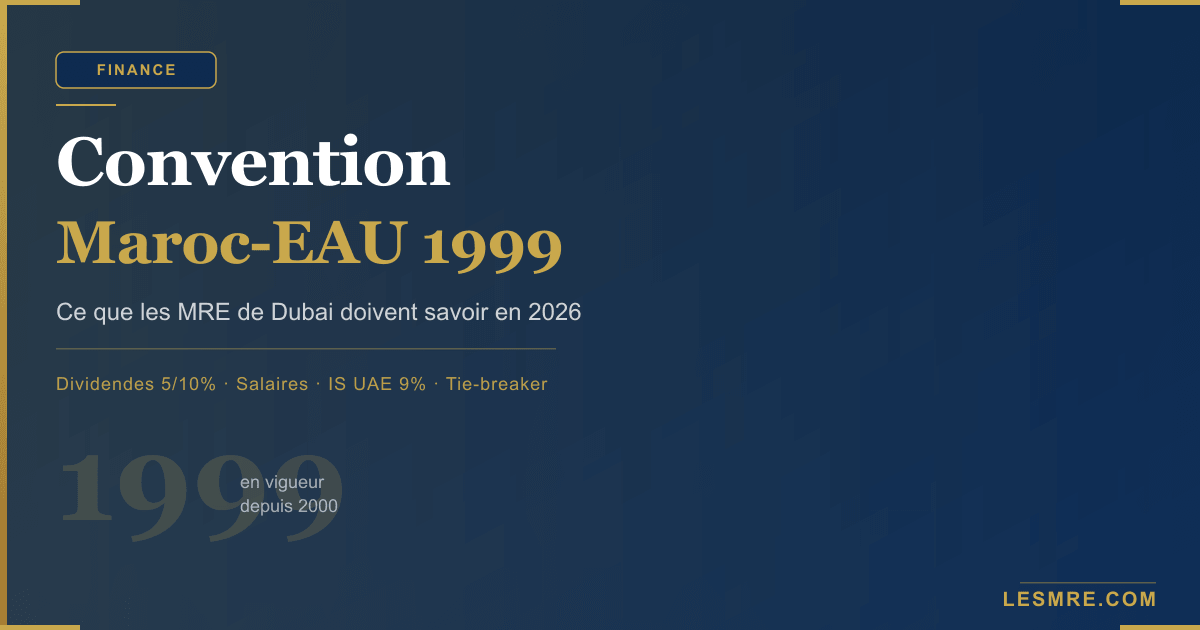
Signed 24 April 1999 and still in force in 2026, the Morocco-UAE non-double taxation convention frames the taxation of MREs based in Dubai, Abu Dhabi or Sharjah. Dividends 5 or 10 %, interest and royalties 10 %, salaries taxed in the country of work: a clear breakdown of the rules and concrete cases for those considering return or dual activity.
Signed 24 April 1999 and still in force in 2026, the Morocco-UAE non-double taxation convention frames the taxation of MREs based in Dubai, Abu Dhabi or Sharjah. Dividends, salaries, interest, royalties: a breakdown of the rules and concrete cases.
Why this convention has become central in 2026
MREs based in the United Arab Emirates number around 75,000 to 90,000 according to consular estimates, concentrated in Dubai, Abu Dhabi and Sharjah. With the US-Iran war that began on 28 February 2026 and the Gulf's economic deterioration (Dubai stock market −16 %, Jebel Ali at a standstill, $120 billion in market cap wiped), many are considering return or patrimonial reorganisation. The tax question then becomes structuring: who taxes what, at what rate, and how to avoid paying twice?
The bilateral Morocco-UAE convention, signed in Abu Dhabi on 24 April 1999 and in force since 2000, is the reference text. It remains applicable in 2026 without major modification and sets precise rules for nine categories of income.
Key rules to know
Tax residence
Residence is determined via cascading criteria: permanent home, centre of vital interests, habitual abode, nationality. An MRE who effectively resides in Dubai for more than 183 days a year is in principle a UAE tax resident. The UAE does not levy personal income tax, but this status determines which country has the primary right to tax.
Dividends (Article 10)
The source country applies a withholding tax capped by the convention:
- •5 % if the beneficial owner is a company directly holding at least 10 % of the capital of the distributing company
- •10 % in all other cases
A UAE-resident MRE receiving dividends from a Moroccan company therefore suffers 10 % withholding in Morocco (instead of 15 % domestic rate). Conversely, dividends from a UAE company received by a Moroccan resident are taxable in Morocco, with credit for any UAE withholding.
Interest (Article 11)
The maximum convention rate is 10 % applied in the source country. Relevant for MREs investing in Moroccan or UAE bonds.
Royalties (Article 12)
The maximum convention rate is also 10 %. Concerns intellectual property royalties, software licences or trademarks exploited from one country to the other.
Salaries (Article 15)
General rule: salaries are taxable in the country where the work is physically performed. An MRE employee actually working in Dubai is taxed in the UAE (i.e. at 0 % personal income tax). Specific exceptions:
- •Short-term mission (< 183 days over 12 months) with home-country employer
- •Permanent establishment of the employer in the host country
Real estate capital gains (Article 13)
Real estate capital gains are taxable in the country where the property is located. A Dubai-resident MRE selling an apartment in Casablanca is therefore subject to Moroccan taxation on the gain (TPI at 20 % under 2026 Finance Act, exemptions depending on holding duration).
Elimination of double taxation (Article 23)
The convention provides two alternative methods:
- •Tax credit method: income is taxed in both countries, but tax already paid in the source country is credited against tax due in the residence country
- •Exemption-with-progression method: income is not retaxed in the residence country but enters the base for the rate applicable to other income
In practice, Morocco mainly applies the tax credit method for its residents.
Specific transfer pricing article
The convention provides that in case of transfer pricing adjustment by one tax administration (e.g. the Moroccan tax authority requalifying an intragroup transaction), the other administration must seek an "adequate solution" to avoid economic double taxation. This is a protective mechanism for holdings and groups straddling Morocco and the UAE.
Three concrete MRE cases
Case 1, Salaried in Dubai for 5 years
Profile: Karim, IT engineer at an Emirati group, resides in Dubai. Salary 35,000 AED/month, no Moroccan income.
Tax: 0 % personal income tax in UAE (national regime), 0 % in Morocco (non-resident, no Moroccan income). Convention has no direct impact.
If returning to Morocco: becomes Moroccan tax resident upon effective relocation (+ vital centre). Future salary subject to Moroccan IR standard scale. If hired by a CFC company, can benefit from 20 % flat IR for 10 years (2026 Finance Act reform = 10 non-consecutive years). To negotiate with Moroccan employer at the recruitment interview.
Case 2, Dubai entrepreneur with Moroccan dividends
Profile: Salima, director of a consulting firm at DIFC, also receives dividends from a Moroccan SARL she owns 100 %. UAE tax resident.
Moroccan dividend tax: source withholding in Morocco capped at 10 % by the convention (vs 15 % domestic, or 5 % if she structured via a UAE company holding ≥ 10 % of capital). Net dividends are repatriated to Dubai without further taxation.
Possible optimisation: inserting a UAE company between Salima and the Moroccan SARL drops the withholding to 5 %, a 5-point tax gain. Structuring cost to weigh (between 30,000 and 80,000 AED initial fees depending on free zone).
Case 3, Casablanca patrimonial holding owning Dubai subsidiary
Profile: Youssef, MRE residing in France but having created a Casablanca holding owning 100 % of an operational JAFZA Dubai subsidiary.
Dividend upstream: Dubai subsidiary pays the Casa holding. Convention applicable: source withholding in UAE capped at 5 % (holding > 10 %). In Morocco, these dividends can benefit from the mother-daughter exemption under 12-month minimum holding conditions.
If the holding has CFC status: additional withholding tax exemption on the Moroccan side when redistributing to non-resident shareholders.
Pitfalls to avoid
- •
Confusing "no UAE tax" with "convention exemption". The UAE not levying personal IR (so far), many MREs believe the convention has no effect. Wrong: the convention remains applicable for Morocco → UAE flows and conditions Moroccan-side withholding.
- •
Failing to formalise tax residence. An MRE spending 7 months in Dubai and 5 in Casablanca can be qualified as resident of both by each administration. The convention has tie-breaker rules but their application requires evidence (electricity bills, school enrolments, main bank accounts) kept for 6 years.
- •
Overlooking the 9 % UAE corporate tax. Since June 2023, the UAE introduced a 9 % corporate tax above 375,000 AED of profits. This changes the equation for MRE holdings: combined UAE + Morocco-side withholding reformulates structures that dated from before 2023.
- •
Forgetting French declaration for France-resident MREs. An MRE returning to France after Dubai retains French declarative obligations on foreign income. The France-UAE and Morocco-France conventions interact, creating complex triangular situations only a registered tax specialist can untangle.
What to do concretely in 2026
For a UAE-based MRE considering return or reorganisation:
- •Consult a Moroccan chartered accountant registered with the Order (oec.ma) AND a UAE-based firm to map flows Morocco / UAE / third countries (France, Belgium, Netherlands depending on passport)
- •Keep UAE tax documentation (FTA-issued residence certificate, employment contracts, banking attestations) before any return
- •Anticipate the switch: 6 to 12 months of transition are needed to optimise exit without penalty
- •Evaluate CFC status if you plan international activity in Morocco post-return (dedicated CFC guide)
- •Frame the move with your employer if salaried: an intragroup Dubai → Casablanca transfer must come with a clear addendum on tax residence and salary payment
The Morocco-UAE convention is not magic. It avoids double taxation but creates no additional tax advantage. To really benefit from Morocco in 2026, it is the convention + CFC status + Investment Charter combination that makes the difference. See also: Relocating your Gulf company to Morocco in 2026.
Related articles


Related practical guides
Are you an MRE?
Join the platform and reach verified professionals in Morocco. Free.
Have a project in Morocco?
Find a LesMRE-verified expert to guide you through your steps.
Find an expert →