
Morocco: Royal Navy asserts presence off Ceuta amid Spanish claims
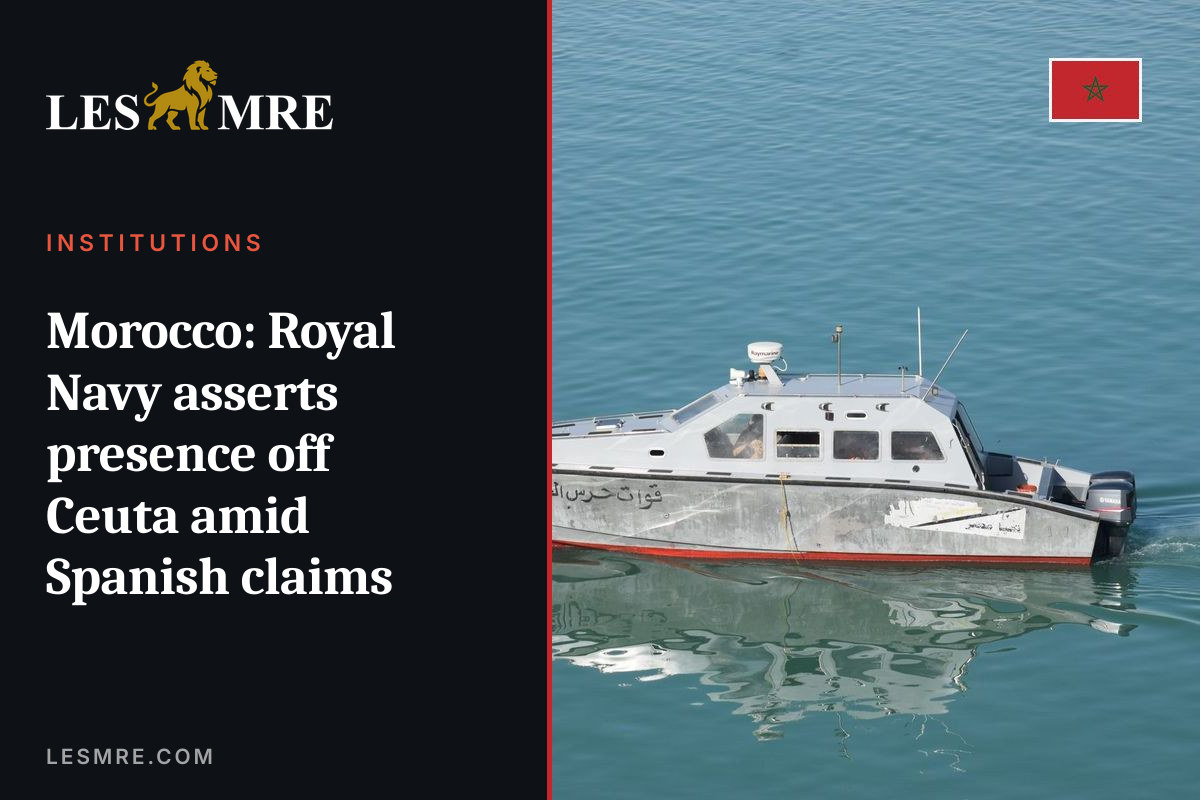
According to La Razón, incursions by Moroccan warships in Spanish waters off Ceuta in late July and early August coincide with a massive migrant entry. El País reveals intentional and repeated incursions, confirmed by Pedro Sánchez. Spain deployed military vessels. The legal framework is disputed.
The incursions of Moroccan warships into Spanish waters off Ceuta, coinciding with the massive influx of migrants across the land border at the end of July and on subsequent dates, warrant reflection that goes beyond the naval incidents themselves and their possible diplomatic consequences, writes La Razón in its 22 October edition. The Spanish daily is reacting to the series of revelations published in mid‑October by El País and picked up by France 24, since confirmed by President Pedro Sánchez.
Ce qui s'est passé fin juillet et début août
On 30 and 31 July, while more than 70,000 people crossed the Ceuta border from Morocco, a frigate and several Moroccan patrol vessels entered Spanish waters without authorisation, reports El País on 15 October, citing a confirmed exclusive. The incursions continued during the first days of August and the tension nearly led to a collision between military vessels of the two countries, the paper adds. According to sources quoted by the paper, this was not an accidental transit but intentional and repeated incursions, reports France 24 on 12 October. In the last few hours, the Spanish prime minister, Pedro Sánchez, confirmed the entry of these Moroccan ships into Ceuta’s waters, the same source notes. Faced with the persistence of the manoeuvres, Spain deployed the maritime action vessel Rayo, then the frigates Santa María and Navarra, which docked at Ceuta on 6 August to transfer a marine infantry team, details France 24.
Ce que montrent les faits : absence de lien prouvé et cadre juridique contesté
The sources consulted by El País have not confirmed that the two episodes responded to a coordinated operation nor conclusively attributed the organisation of the arrivals to Morocco, notes France 24. On the legal front, La Razón recalls on 22 October that Ceuta and Melilla do not appear on the list of territories awaiting decolonisation, unlike Gibraltar or Western Sahara. The daily cites the official declaration deposited by Spain in September 2008, in response to the one formulated by Morocco upon its ratification of the Convention the previous year. Madrid expressly reaffirmed that Ceuta, Melilla and the other Spanish territories in the north form an integral part of Spain, that it exercises full sovereignty over them and their corresponding maritime spaces, and that Moroccan maritime laws are not enforceable against it when they are incompatible with the Convention. The right of innocent passage for warships requires a rapid and uninterrupted transit, and expressly excludes weapons exercises, espionage or any activity unrelated to navigation, specifies La Razón.
La lecture espagnole et la position marocaine implicite
Retired Lieutenant‑General Francisco Gan Pampols states that the incursions aim to “undermine Spanish sovereignty” and constitute destabilising actions, reports El Español on 17 October. He considers routine patrolling in another country’s territorial waters without a cooperation agreement a “clear violation of international law”. The observed manoeuvres, anchoring, course changes, approaches to the coast, call into question “innocent passage” and suggest other intentions, according to the same officer. These incursions fit within a strategy of “hybrid pressure” and “grey zone”, marking a “qualitative leap” in the dynamics of coercion, he analyses. Defence figures reaffirm that Ceuta and Melilla do not belong to Spain but that they are Spain, ruling out any negotiation over their sovereignty. Morocco also possesses a major naval installation at Ksar Sghir, some thirty kilometres west of Ceuta, from which the frigate Mohammed VI and Sigma‑class vessels operate, recalls France 24. Moroccan Gendarmerie boats have already entered waters considered Spanish during pursuits of alleged narco‑boats.
The Spanish Constitution entrusts the Armed Forces with the mission of guaranteeing Spain’s sovereignty and independence and defending its territorial integrity.
Sources
- •La Razón (larazon.es), 22 octobre 2026
- •El País (elpais.com), 15 octobre 2026
- •France 24 (france24.com), 12 octobre 2026
- •El Español (elespanol.com), 17 octobre 2026
Related articles


Related practical guides
Are you an MRE?
Join the platform and reach verified professionals in Morocco. Free.
Have a project in Morocco?
Find a LesMRE-verified expert to guide you through your steps.
Find an expert →